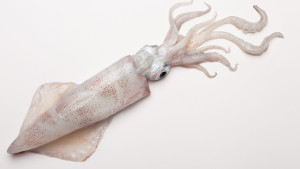
Squid Dissection
In-Booth Demonstration Life Science 6-12 Middle / High School Squid are invertebrates belonging to the phylum Mollusca and class Cephalopoda

In-Booth Demonstration Life Science 6-12 Middle / High School Squid are invertebrates belonging to the phylum Mollusca and class Cephalopoda

In-Booth Demonstration Life Science 6-12 Middle / High School Carolina’s Perfect Solution® sheep brain dissection introduces students to the anatomy

Workshop Resources Life Science 6-12 Middle / High School With the transition to 3-dimensional learning and NGSS, is there still
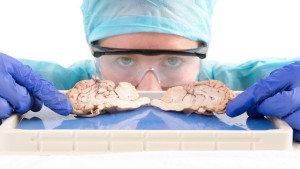
Workshop Resources Life Science 6-12 Middle / High School Show off your surgical skills while you experience the superior quality

In-Booth Demonstration Life Science 9-12 High School Carolina’s Perfect Solution® pregnant rat dissection allows students to develop their dissection and

Workshop Resources Life Science 9-12 High School Dive in and learn how to create your own Shark Week! This session

Workshop Resources Life Science 9-12 High School Explore animal diversity by comparing anatomical adaptations of the pig, rat, dogfish, and
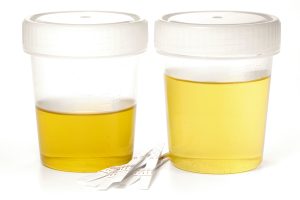
Abnormal urine composition often indicates disease or infection. Diabetes is often diagnosed after a patient has a positive test for glucose in the urine. Diabetes is the result of an inability to absorb glucose from the blood. The body compensates for these elevated blood glucose levels by filtering the glucose out through the kidneys; the excess glucose exits the body through the urine.

Newton’s law of cooling states that the rate at which an object cools is proportional to the difference in temperature between the object and the object’s surroundings. Simply put, a glass of hot water will cool down faster in a cold room than in a hot room. This simple principle is relatively easy to prove, and the experiment has repeatable and reproducible results.
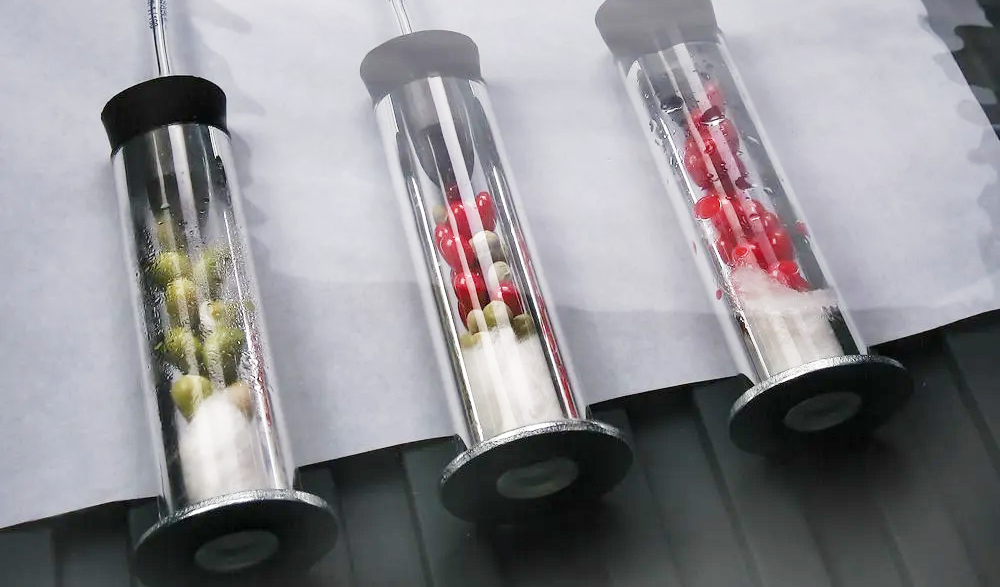
Cellular respiration and fermentation are 2 of the most challenging concepts for introductory biology students, who may become so consumed by memorizing steps of the Krebs cycle and glycolysis that they lose sight of the big picture. The following demonstrations place aerobic cell respiration and fermentation firmly in grasp. First, students observe respiration in germinating seeds by detecting the carbon dioxide produced. Next, they observe the carbon dioxide gas produced by yeast fermentation.


Objective To observe hydrogen’s emission spectrum and to verify that the Bohr model of the hydrogen atom accounts for the

Luminol is a chemical that produces a beautiful blue fluorescence when oxidized by hydrogen peroxide. In addition to providing one
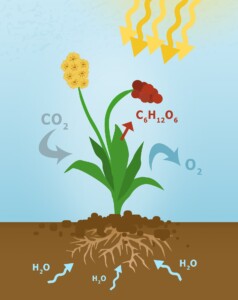
While studying photosynthesis, students can have difficulty understanding how the carbon in CO2 becomes the carbon in glucose (6H2O + 6CO2?C6H12O6 +
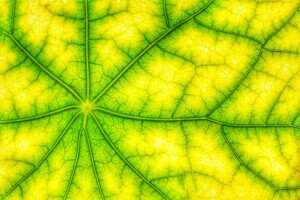
If you have never tried the leaf disk assay, you are missing out on one of the best photosynthesis labs

Introduction Egeria densa, also known as Elodea densa because of its previously incorrect classification in the Elodea genus, is the most popular aquatic plant

For chemistry teacher Siobhan Julian, teaching the history of atomic theory by lecture “was dry and tedious and boring for everyone involved.†Then she took a fresh approach—one that focuses on doing science to learn science history.

Introduction This laboratory activity explores the topics of stoichiometry and limiting reactants in a fun, delicious way! Mass/mole relationships and