How to Make Luminol Glow: Glowing Reaction Activity
|
Carolina Staff
|
Carolina Staff
|
Introduction
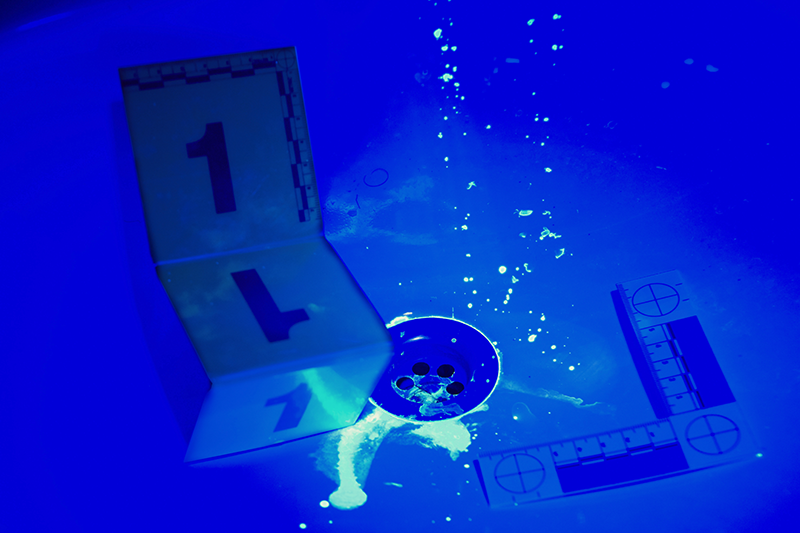
Luminol is a chemical that produces a beautiful blue fluorescence when oxidized by hydrogen peroxide. In addition to providing one of the best-known examples of chemiluminescence, it is also a valuable crime scene investigation tool whose blue glow reveals the presence of blood.
For teachers, demonstrating the luminol reaction can add to discussions of oxidation-reduction reactions, conservation of energy, and electron energy levels. The following demonstration is ideal for middle and high school students.
Evidence of hidden stains on place of bloody crime
Standards
This activity addresses the following AP® Biology concepts:
SYI-1
Living systems are organized in a hierarchy of structural levels that interact.
SYI-1.A
Explain how the properties of water that result from its polarity and hydrogen bonding affect its biological function.
SYI-1.A.3
The hydrogen bonds between water molecules result in cohesion, adhesion, and surface tension.
Activity
Preparation
You will need a separate beaker for each of the 2 stock solutions you’ll prepare. Prepare the solutions immediately before use. Don lab coat or apron, goggles, and gloves before preparing solutions. Caution: Hydrogen peroxide is a strong oxidizer. Avoid skin contact. Sodium hydroxide and its solutions are caustic and can irritate skin. Avoid skin contact.
To prepare stock solution A, fill a beaker with 100 mL of water. Add 0.18 g of luminol and 3.0 mL of sodium hydroxide solution (1 M).
To prepare stock solution B, fill another beaker with 100 mL of water. Add 1 mL of hydrogen peroxide (3%) and 0.03 g of potassium ferricyanide.
Procedure
Dim the lights.
Simultaneously pour an equal amount of solution A and solution B into the funnel.
As the 2 solutions mix, a blue light is emitted that is relatively bright and should last for several minutes.
Discussion
Reactions that produce light without heat are called chemiluminescent reactions. Perhaps the most familiar chemiluminescent reactions are those that occur in living organisms and are referred to as bioluminescence. A classic example of this is the light produced by fireflies.
The reaction in this demonstration is an oxidation-reduction reaction in which a photon of light is released from an excited molecule. In the reaction, luminol is oxidized and its electrons elevated to an excited state. When the electrons return to the ground state, visible light is emitted.
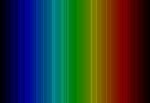
Light’s wavelength determines its color. Light at a wavelength of 680 nm is red; at 500 nm, green; and at 425 nm, blue. The energy of one quantum (one photon, one particle) of light is inversely proportional to its wavelength. Thus:E = hc/l
where E is the energy of one quantum of light of wavelength (l), h is Planck’s constant and c is the speed of light.
Carolina is teamed with teachers and continually provides valuable resources–articles, activities, and how-to videos–to help teachers in their classroom.