Introduction
Explore the pigments that give plants their colors
The activity is designed for middle school students and explores the pigments that give autumn leaves their flamboyant colors.
The shorter days and cooler temperatures of autumn trigger a slowdown in a tree’s metabolism, reducing its chlorophyll production and the flow of water and nutrients within its trunk and branches. Its leaves turn color because the reduced production of chlorophyll allows other less-dominant pigments to be revealed. Chlorophyll, carotenoids, and anthocyanins are the basic pigment groups responsible for plant colors. There are many types of each of these pigments, and they can be broadly grouped by water solubility. Anthocyanins are water soluble, but chlorophyll and carotenoids are not. This activity will help you determine if a plant pigment is water soluble.
Activity Details
- Prep Time: 10 minutes
- Class Time: 30 minutes
- Grade: Middle School
- Subject: Chemistry
Materials
- Cutting board
- Ethanol
- Flower petals, leaves, vegetables, and fruits
- Kitchen knife
- Test tubes
- Water
Procedure
Preparation
Safety notes: Use caution when chopping specimens with the knife. Keep ethanol away from open flames and other sources of ignition.
- Select a variety of flower petals, leaves, vegetables, and fruits to test.
- Chop each specimen finely (you may want to do this for middle schoolers) and divide it in half.
- Place a small amount of a specimen in 2 test tubes.
- Add water to one of the tubes; just enough to cover the chopped specimen.
- Add the same amount of ethanol to the other tube.
- Observe the contents of both tubes.
Explanation
If the specimen colors the water, then its pigments are water-soluble anthocyanins. Flower petals and strawberries are good examples of these. If the specimen colors the ethanol instead, then its pigments are carotenoids and chlorophyll, which are not water soluble. Carrots and leaves contain these pigments.Chromatography is a technique used to separate different pigments in a specimen. You can demonstrate the concept by using a felt tip pen with black water-soluble ink to draw a big dot on filter paper. Allow the paper to dry, and then slowly add single drops of water to the dot to see the colors in the black ink separate.
Extension Activities
Chromatography is a technique used to separate different pigments in a specimen. You can demonstrate the concept by using a felt tip pen with black water-soluble ink to draw a big dot on filter paper. Allow the paper to dry, and then slowly add single drops of water to the dot to see the colors in the black ink separate.
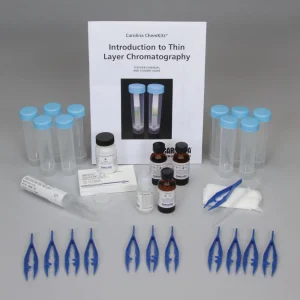
Carolina ChemKits®: Introduction to Thin Layer Chromatography Transformative Properties of Water
Teach your students the fundamentals of thin layer chromatography with this classic experiment in separation science.