
Home / All Science / Interdisciplinary / Forensics / Micropipetting – Copy
Lab Skill

Micropipetting – Copy

Free teaching resources to help students master a fundamental, hard-to-perfect lab skill — before they need it for transformation and gel electrophoresis labs.
WATCH

Lab Skills Walkthrough Video

Introduce students to using and setting a micropipette with our micropipetting lab skills walkthrough video.

Prepares students for

Transformation · Gel electrophoresis

Teach & Practice

Free Classroom Resources

handout · pdf

How to Use a Micropipette

Step-by-step student guide that builds the same skills molecular biologists and forensic scientists use.

poster · pdf

How to Micropipette

A wall reference that connects the skill of micropipetting and how the practice is used for scientific advancement.

free activity

On Your Mark, Get Set, Pipette!

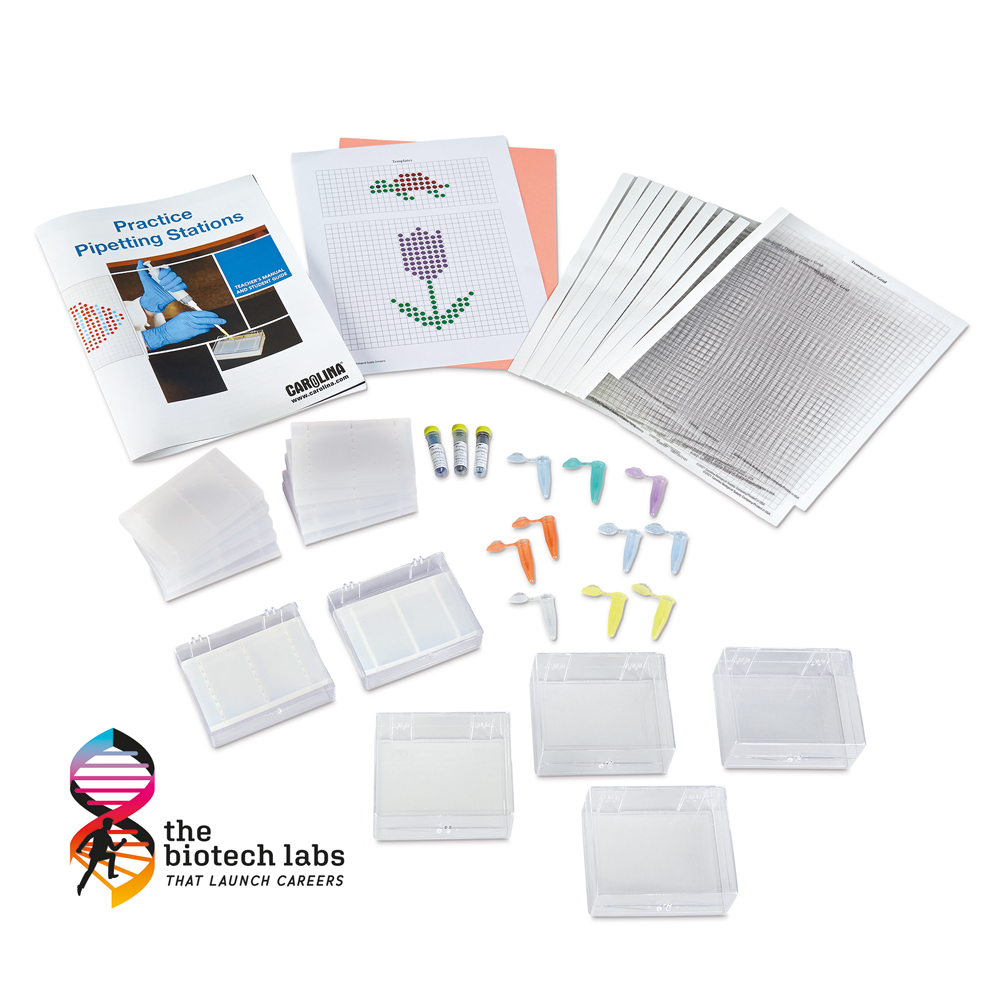
This workshop provides unique activities that will support your students toward excellence in micropipetting technique!

Why practice now?

Lab skills fade between classes and time away from the lab. Regular practice keeps students ready for biotech work in your course and connects them to skills used in real careers.

Frequently asked questions

Quick answers for planning your micropipetting lessons.

A real experiment that needs it: students tend to retain the skill better when they practice it right before using it, rather than learning it in isolation.

For a standard air-displacement micropipette (the common kind, like Gilson or Eppendorf models), the plunger has two resistance points:

First stop is the measuring stop. Pressing to it pushes out exactly the volume you’ve set on the dial.

  • To draw liquid: press to the first stop, put the tip in the liquid, and slowly release. The pipette pulls in your set volume.
  • To dispense: press to the first stop. Most of the liquid comes out.

Second stop is the blow-out stop. Pressing past the first stop, you’ll feel extra resistance, and then the plunger goes a bit further.

  • Use it only when dispensing, after the first stop, to push out the last drop clinging to the tip.
  • Never press to the second stop before drawing liquid. If you do, you’ll pull in more than your set volume. This is probably the most common beginner mistake.

Micropipetting is a basic hands-on skill in almost any job that handles small amounts of liquid samples. 

Careers where it’s used routinely:

  • Research science (biology, biochemistry, genetics, neuroscience). Research associates and lab technicians in universities and companies pipette daily, setting up experiments like PCR, cell cultures, and protein assays.
  • Clinical and medical lab work. Clinical lab scientists and medical lab technicians process patient samples. Many high-volume hospital labs now use automated machines, so manual pipetting there may be less constant than in research labs. 
  • Pharmaceutical and biotech industry. Drug discovery, quality control, and manufacturing testing all involve precise liquid handling.
  • Forensic science. DNA analysis in crime labs relies on careful pipetting, partly because contamination or volume errors can affect evidence.
  • Public health and environmental testing. Labs that test water, food, or disease samples use it, as many did heavily during COVID-19 testing.
  • Agriculture and food science. Plant genetics, food safety testing, and similar work.

More foundational lab skills

Resources that help teachers and students build the skills they need to succeed.

Newsletter Signup

Get the latest news, free activities, teacher tips, product info, and more delivered to your inbox.
Please login or register to save your favorite articles and activities to your library!