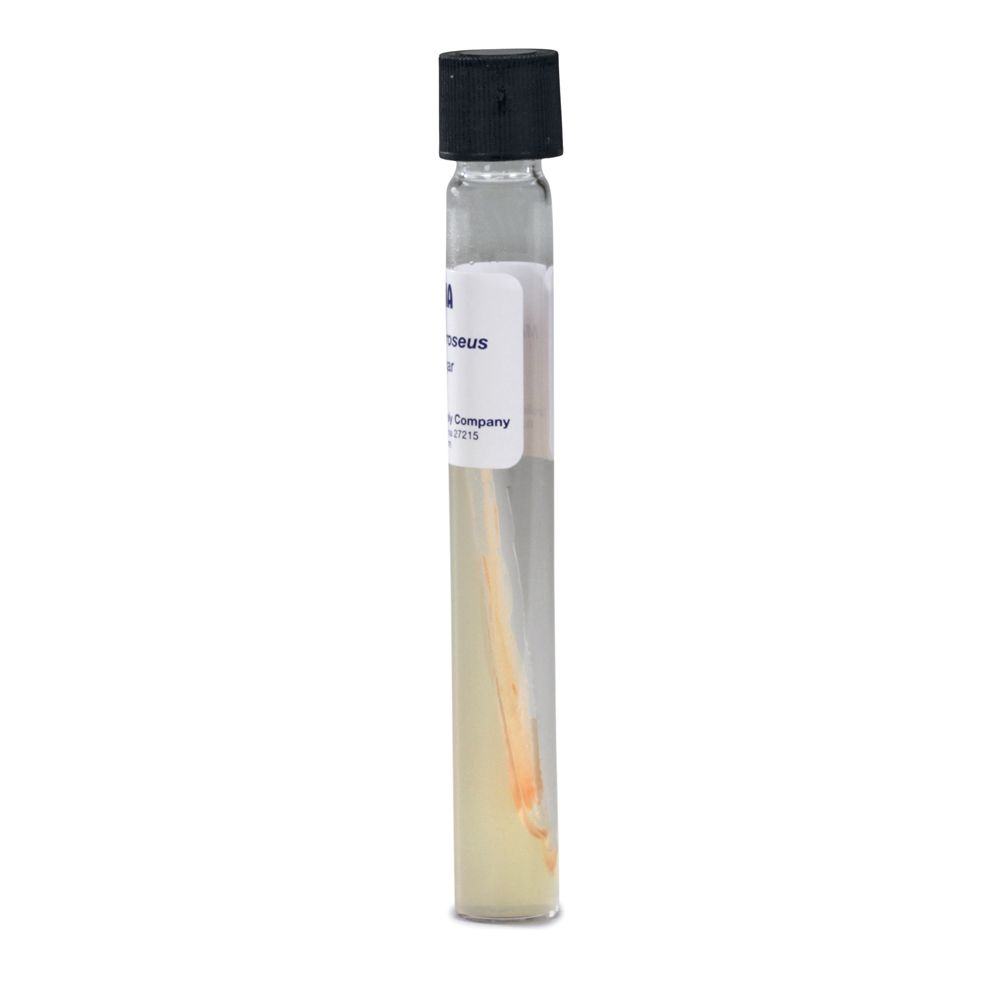
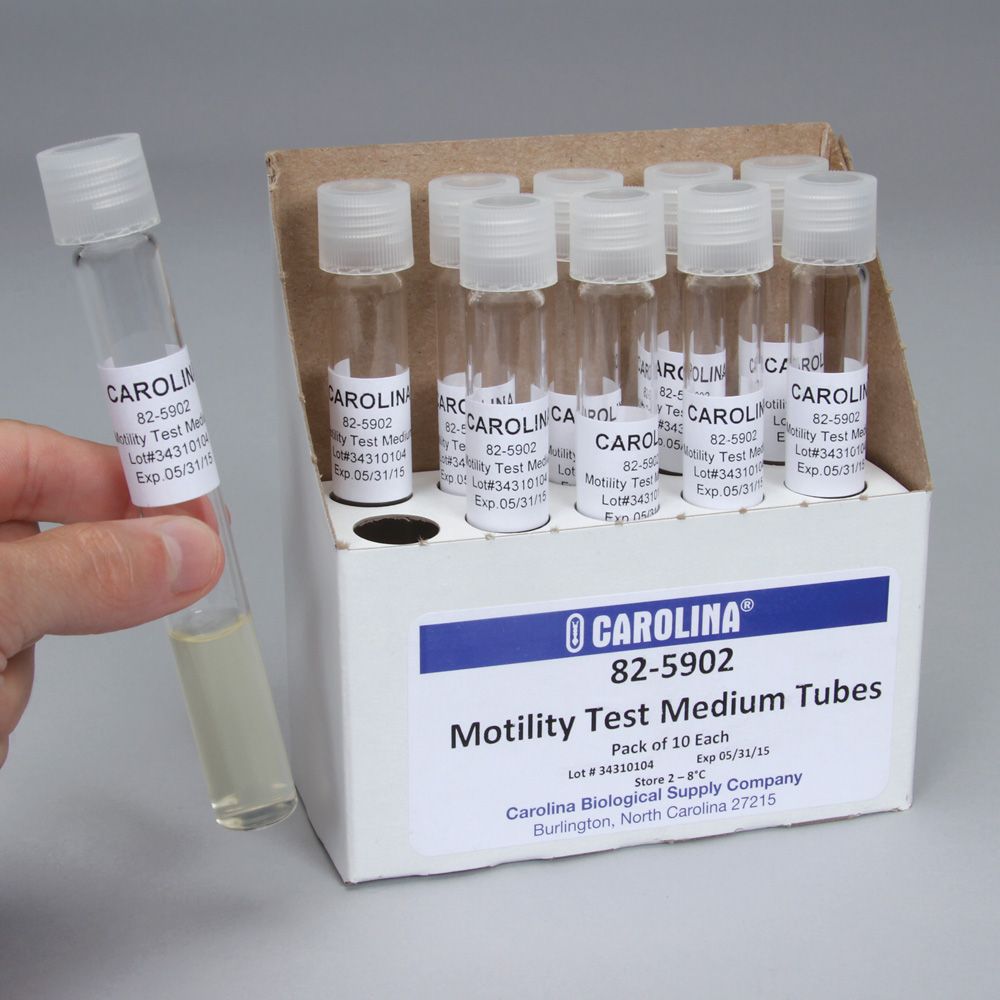
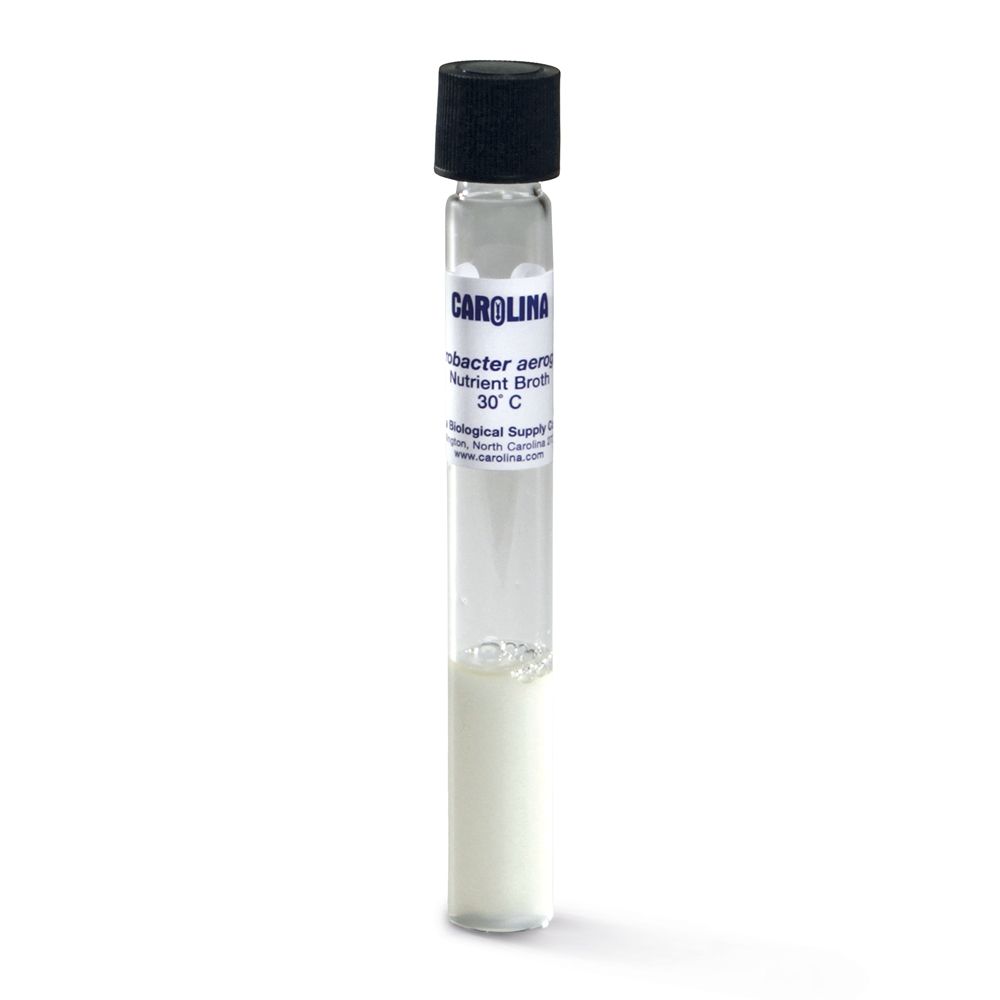
In this lab, students perform two exercises that investigate microbial motility. One is on a microscopic level, using the “hanging drop” slide preparation method to directly observe motile cells. The second exercise is on a macroscopic level and involves inoculating motility test media. The MIO media used in this exercise (825862) also screens for indole and ornithine decarboxylase activity.
This activity assumes that students have previously worked with bacteria and are familiar with sterile technique. If this is not the case, we recommend that students complete the activities described in our “Introduction to Sterile Technique” LabSheet before beginning this activity.
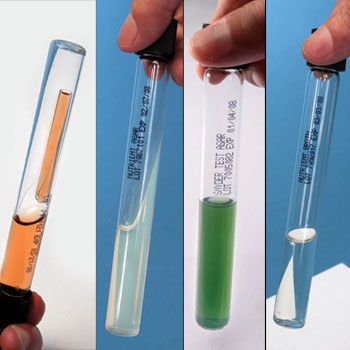
Designed for use with Enterobacter aerogenes and Escherichia coli species of bacteria.
Slides 294198 (Polar Amphitrichous [Spirillum volutans], w.m.) and 294204 (Peritrichous [Proteus vulgaris], w.m.) are stained to show bacterial flagella.
You can substitute 825902 (Motility Test Medium Agar without TTC) or 825903 (Motility Test Medium Agar with TTC) for 825862 MIO media. Note: Neither of these substitutes is suitable for indole testing.
TTC (triphenyl tetrazolium chloride) is reduced by bacterial dehydrogenases, changing from clear to red. If the red color is restricted to the area of the stab, the bacterium is nonmotile. If the bacterium is motile, the red color spreads out from the stab. If the bacterium is highly motile, the entire tube of medium could become red.
Ensure that students understand and adhere to safe laboratory practices when performing any activity in the classroom or lab. Demonstrate the protocol for correctly using the instruments and materials necessary to complete the activities, and emphasize the importance of proper usage. Model proper laboratory safety practices for your students and require them to adhere to all laboratory safety rules.
This activity requires that students work with bacterial cultures and open flames. Have students use sterile technique at all times and wear appropriate safety equipment (such as safety glasses or goggles, gloves, and aprons).
Have them wipe down all work surfaces with disinfectant before and after the lab, and wash their hands after entering and before exiting the lab. Disinfect cultures and any contaminated items remaining at the end of the lab by autoclaving them or by flooding them with disinfectant overnight before proper disposal.
Students can work individually, if desired, but students working in pairs will have the chance to both inoculate their media and share the duties in preparing the hanging drop slide. Both can share a microscope to observe and record their findings.
Optimal incubation temperatures are 30°C for Enterobacter areogenes and 25°C for Micrococcus roseus. Both can be incubated at room temperature, but it might take longer to obtain results.
Each group will need the following:
Each group will need the following:
Brownian motion can sometimes be mistaken for motility. If a cell is truly motile, it will move over a distance and not simply vibrate back and forth. Bacterial cells are most motile during the log phase of growth and may lose their motility as the culture ages.
Optional: Other bacterial cultures can be tested in addition to or instead of the ones recommended above. Note that the hanging drop method is not safe for use with bacterial cultures that we list as pathogens. MIO medium also can be used to test for indole production; see our “Bacteria: The Indole Test” LabSheet for details.

Get the latest news, free activities, teacher tips, product info, and more delivered to your inbox.