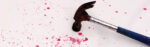
Blood is among the basic types of physical evidence often encountered at a crime scene. Investigators use blood evidence to identify individuals by both blood type and DNA. By observing and analyzing patterns formed by blood at a scene, they can restage the location, movement, and actions of the crime. Like other physical evidence, blood evidence often links a scene, perpetrator, and victim and can be used to determine a sequence of events.
This activity addresses the following AP® Biology concepts:
SYI-1
Living systems are organized in a hierarchy of structural levels that interact.
SYI-1.A
Explain how the properties of water that result from its polarity and hydrogen bonding affect its biological function.
SYI-1.A.3
The hydrogen bonds between water molecules result in cohesion, adhesion, and surface tension.
Activity
Procedure
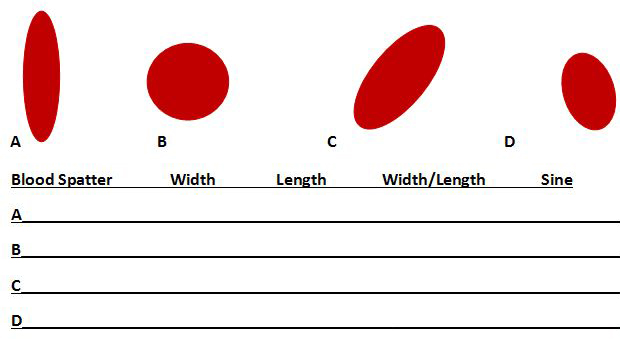
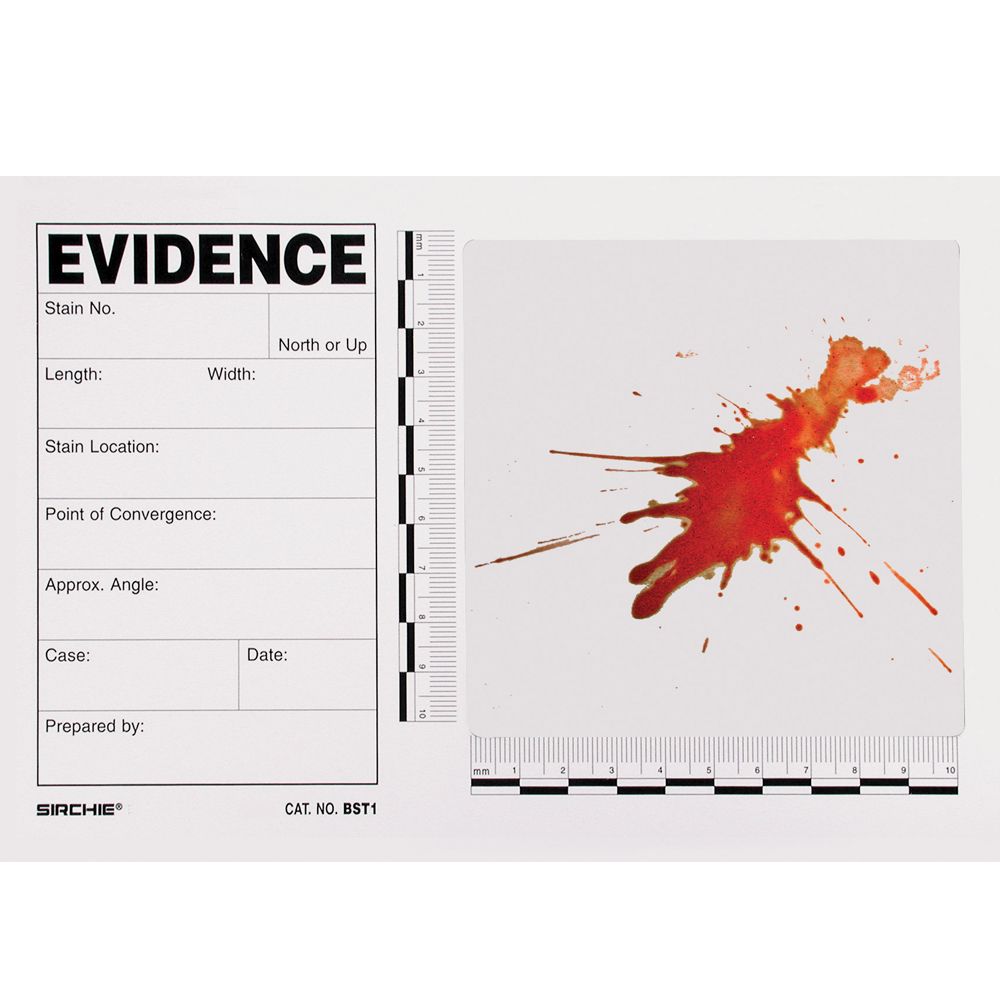
On the blood spatter card, use a straight edge and draw a straight line bisecting the blood spatter ellipse lengthwise.
Draw a straight line bisecting the blood spatter ellipse widthwise.
Measure the lengthwise bisecting line of the blood spatter ellipse and record the spatter’s length in millimeters. (When measuring a spatter drop that has a thin tail, do not include the tail in the length measurement.)
Measure the widthwise bisecting line and record the spatter’s width in millimeters.
Repeat steps 1—4 for each example.
Divide the width measurement by the length measurement and record the answer.
Calculate the angle of incidence for each drop by using the inverse sine function of a calculator or by looking up the value on a sine function chart. The inverse sine of width/length is the angle of incidence.
Assume all of the blood spatters were found on a flat, horizontal surface. Draw an arrow through the blood spatter indicating the direction of blood flow.
Calculate the sine of each of the angles of incidence for each bloodstain spatter. Add it to your data table.
What can the angle of incidence tell us about the crime being investigated?
Carolina is teamed with teachers and continually provides valuable resources–articles, activities, and how-to videos–to help teachers in their classroom.