Introduction
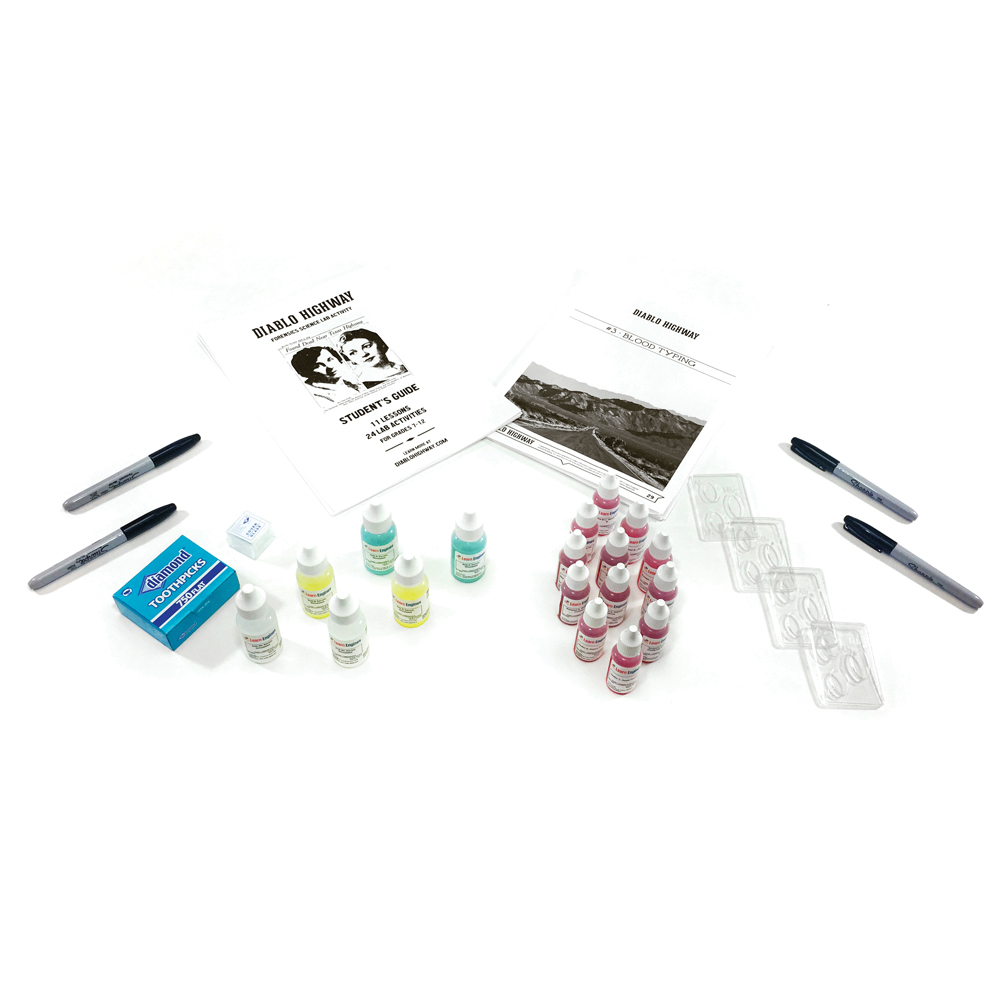
In this blood typing activity, students will observe how antigens on red blood cells interact with specific antibodies. These reactions will help students identify whether a sample belongs to blood type A, B, AB, or O, and whether it is Rh-positive or Rh-negative. By analyzing the results, students will gain a deeper understanding of genetics and how it relates to forensic investigation.
Activity Details
- Prep Time: 15 minutes
- Class Time: 45-60 minutes
Materials
- Carolina® Luminol Reactive Forensic Blood, 250 mL
- Multiple Blood-like Substances (simulated blood, ketchup, hot sauce, etc.)
- Luminol, 0.18 g
- Luminol Blood Detection Student Investigation Sheet (one per student)
- Surface for Blood Stains (fabric or wood preferred)
- Clorox 2 Powder, 10 g
- Water, 60 mL
- Small Spray Bottle (preferred) or Drop Bottle
Overview
Investigation question
Investigation objective
Safety

Standards
This activity addresses the following AP® Biology concepts:
SYI-1
Living systems are organized in a hierarchy of structural levels that interact.
SYI-1.A
Explain how the properties of water that result from its polarity and hydrogen bonding affect its biological function.
SYI-1.A.3
The hydrogen bonds between water molecules result in cohesion, adhesion, and surface tension.
Activity
Procedure
Mix/shake all vials well before starting the activity.
Record in data table the number of each blood sample.
Using one of the blood samples, place a drop into each well of the blood-typing slide.
Add a drop of synthetic anti-A serum (blue) to the well labeled A and replace the cap.
Add a drop of synthetic anti-B serum (yellow) to the well labeled B and replace the cap.
Add a drop of synthetic anti-Rh serum (clear) to the well labeled Rh and replace the cap.
Using a different color mixing stick for each well (blue for anti-A, yellow for anti-B, white for anti-Rh), gently stir the synthetic blood and antisera drops for 30 seconds. Discard each mixing stick after a single use to avoid contaminating your samples.
Examine the thin films of liquid mixture. If the film remains uniform, there is no agglutination. If the sample appears granular or clumpy, agglutination has occurred. Record in the table positive agglutination or no reaction for each well.
Clean the blood typing slide and repeat the procedure for the remaining blood samples.
Analysis
Identify the blood type of each sample you tested.
Describe the cause of agglutination when performing a real blood typing test.
Explain how blood typing can be used to connect a suspect to a blood sample found at a crime scene.
Examine the global distribution of blood types below to answer questions 4 and 5.
| Global Distribution of Blood Types | ||||||||
|---|---|---|---|---|---|---|---|---|
|
Blood Type: |
A+ |
A- |
B+ |
B- |
AB+ |
AB- |
O+ |
O- |
|
Percent of Population: |
31% |
2.5% |
15% |
1% |
5% |
0.5% |
42% |
3% |
4. What influence does the blood type of a suspect have in a forensic investigator’s ability to narrow down between suspects in the population of a small town? City? State?
5. Considering that the global population is over 8 billion (and growing), what are some limitations of using blood typing for forensics identification?
6. List other types of biological tests that can be performed on biological evidence such as blood. When and why would the tests you listed be preferred by forensic scientists instead of blood typing?
Sample Answers
| Sample 1 | Sample 4 | |
|---|---|---|
| Anti-A | Agglutination | No reaction |
| Anti-B | Agglutination | No reaction |
| Rh | No reaction | No reaction |
| Blood Type | AB- | O- |