
Daphnia, commonly known as the water flea, is a planktonic crustacean that lives in freshwater bodies of North America and Europe. Some species can briefly tolerate saltwater but will not reproduce. Daphnia belong to the Phylum Arthropoda, Subphylum Crustacea, Class Phyllopoda (or Branchiopoda), and Order Anomopoda, and are characterized by flattened leaf-shaped legs producing a water current as a filtering apparatus. Within branchiopods, Daphnia belong to the Cladocera, whose bodies are enclosed by an uncalcified shell known as a carapace. Two of the most common species, Daphnia magna (d. magna) and Daphnia pulex (d. pulex), are ideal animals for classroom experimentation because they are useful for demonstrating many biological phenomena, and a Daphnia culture is easy to maintain. (See our care guide.) Daphnia populations thrive in a living “green water” environment that can be a simple jar or aquarium of living green algae and healthy individuals from the family Daphniidae. Daphnia and Moina (a related water flea) can be cultured together successfully.
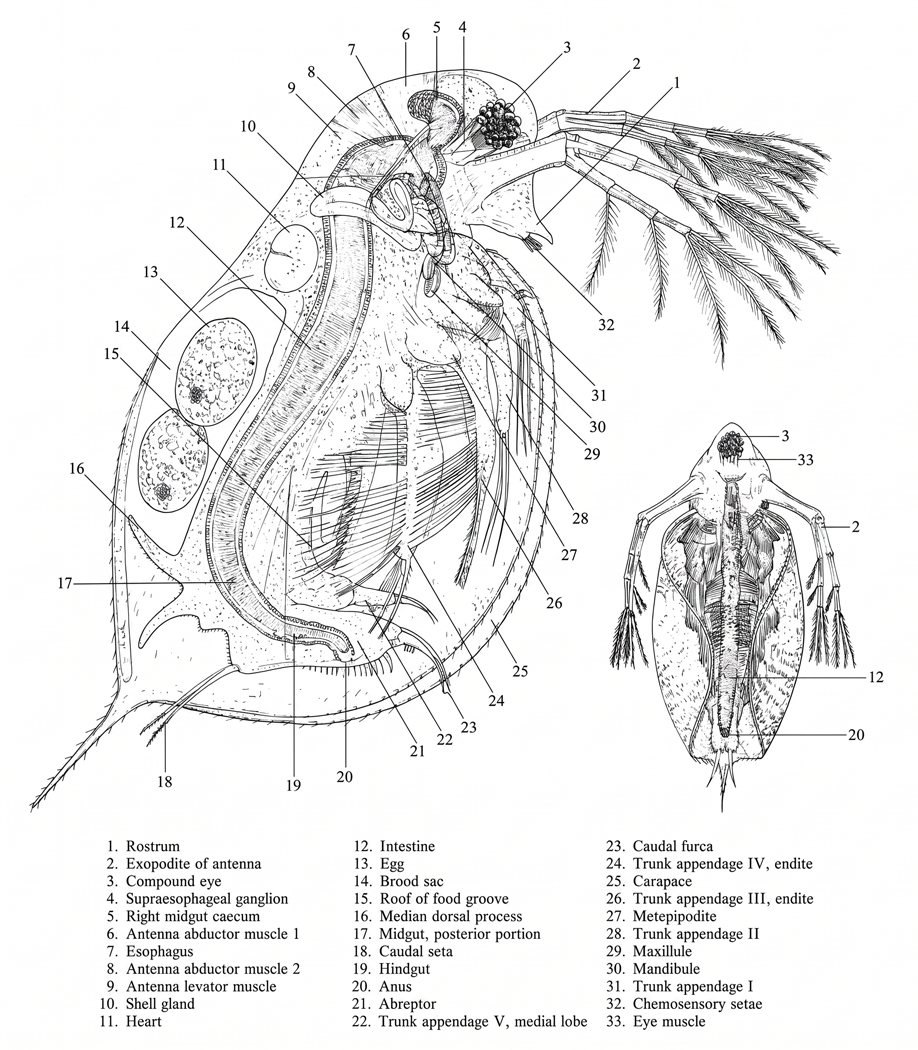
Species of Daphnia range in size from 0.5 to about 5.0 mm in length. Daphnia (Fig. 1) has a transparent bivalve carapace that encloses the body except for the head and antennae. A large conspicuous compound eye (located in the head) is sensitive to changes in light quality, quantity and polarization. The smaller ocellus, located close to the compound eye, is sensitive to ultraviolet light. The light-influenced movement of Daphnia though a water column is a highly interesting aspect of its activities. The water flea is characterized by its “jerky” method of propulsion. The large antennae are used as oars, causing the body to “jump forward” as the antennae are stroked.
Daphnia is an algal filter feeder and is the first consumer level in a food chain. The thoracic legs act as sieves for filtering algae, bacteria, and small food particles and debris from the water. Food is transferred to the mouth, where it is ground by the mandibles and moves through the gut for digestion. Retention of food is from one-half to three hours. Well-nourished Daphnia viewed under a microscope may show a green gut, indicating recent feeding.
As in all arthropods, growth occurs immediately following molting in its life cycle. Some water fleas can live at least 100 days under optimum conditions. Preadult instars often molt once a day, while adults molt every two or three days. Daphnia becomes reproductively mature in the 3rd to 6th instar (depending on species), and under favorable conditions produces broods of 4 to 65 young just prior to every molt.
Reproduction is by parthenogenesis, giving rise to populations that are entirely female until environmental stress such as overcrowding, lack of food, or temperature changes occurs. Then, males are produced and sexual reproduction results in two “resting eggs.” These sexual eggs are enclosed in a single, darkly pigmented, saddle-shaped case (ephippium) that is highly resistant to adverse environmental conditions. When conditions again are favorable, these ephippial eggs hatch into females, which then reproduce parthenogenetically.
As mentioned above, culture Daphnia in a clean glass container (e.g., gallon jar, battery jar, aquarium) or use a Daphnia culture kit, which includes Daphnia, a nutrient food source, and aquarium. Use filtered pond water or conditioned tap water, i.e., water that has been allowed to sit for several days so it is chlorine-free. Cover the container with a glass plate to keep out dust, and add distilled water when the water level drops. Gently aerate the container. If the air is supplied by a central compressor, pass the air through an Erlenmeyer flask stuffed with cotton before bubbling it into the aquarium. This will remove any oil or dirt in the airlines. Maintain a temperature of 21° ± 2° C (70° ± 3° F). Temperature variation affects the metabolism of Daphnia, Light intensity should be 15 to 50 footcandles. If the aquarium is in “average” laboratory lighting, a dark cover placed on top of the glass plate will sufficiently reduce the light intensity.
Feed the Daphnia two or three times a week. In general, if a culture remains turbid for longer than eight hours, it has been overfed. Any of the following foods may be used successfully:
1. Motile algae.
2. Yeast Suspension. (Addition of about 5 cm³ of yeast every three days to a 40-liter aquarium should be sufficient. Be careful not to add so much that the tank becomes fouled.)
3. Bacteria. Can be induced by addition of:
(a) freshly boiled egg yolk;
(b) filtrate of trout chow, ground and passed through fine bolting cloth;
(c) infusion of a boiled lettuce leaf;
(d) infusion of ‘‘stable tea” (soil and manure); or
(e) infusion of soil and soybean meal, soil and cottonseed meal, or wheat grain.
Cultures kept in this manner should thrive indefinitely. Do not remove the debris from the bottom because it contains microorganisms upon which the Daphnia feed. Eventually, with overcrowding or the accumulation of metabolites, Daphnia begin to produce ephippia, and the population drastically decreases. When this happens, either drain half of the tank and refill with fresh water or remove animals with a fine net, clean the aquarium, and begin again. In either case, discard about one-half of the animals.
Cladocerans should always be transferred by using a wide-bore pipet so delicate appendages are not damaged. They should be introduced under the water surface to prevent air bubbles from being caught beneath the carapace, thus trapping the animals on the surface. Daphnia morphology can be studied by simply placing a drop of water containing a single daphnid on a slide and withdrawing the water with a fine pipet. Leave enough water to barely cover the animal.
It is simple to restrain Daphnia, yet allow free movement of the appendages. Place a small amount of Vaseline in the bottom of a Syracuse watch glass and cover with water. Add a Daphnia to the watch glass, and then carefully withdraw the water so the animal falls on its side and adheres to the Vaseline. Cover the entire preparation with water. The Daphnia will be held firmly in place by the Vaseline, thus facilitating observation of appendages and internal organs.
Since Daphnia are small, hardy invertebrates, reproduce prolifically, and are easy to care for, they make wonderful specimen for classroom experiments and independent student research. Experimental variables can be clearly defined and quantitative data easily measured, allowing students to practice experimental design skills in a group or individual independent setting. The experiments that follow include options for both classroom and independent study with varying duration to best suit classroom needs and standards.
Prepare a Vaseline wet mount and observe under a stereomicroscope (the scanning lens of a compound microscope also can be used). The Daphnia can be fed a suspension of congo-red- stained yeast, prepared as follows. Mix together 3 g of compressed yeast, 30 mg of congo red stain, and 10 cm³ of water. Boil gently for 10 minutes. Dip a dissecting needle into the congo- red-stained yeast and then stir gently above the head of the Daphnia. This should add the proper amount of food. Do not overfeed, as excess yeast will obscure observation of the current flow.
Filter feeding can be observed in this manner. Students may take notes on what occurs and
sketch the paths of water currents, which are set up by the movements of the appendages.
Movement of the food through the gut can be observed easily using this method. Also, pH
changes that occur as the food is processed can be monitored by the color changes of the
congo red. This stain is bright orange red above pH 5.0 but is blue at pH 3.0.
A more graded series of changes in pH can he observed by adding daphnids to a dilute aqueous solution of neutral red stain (0.02 percent or less) for about 15 minutes. Remove the organisms and observe. The dye in the digestive tube is red below pH 6.0, rose at pH 7.0, orange at pH 8.0, and yellow at pH 9.0.
As a convenient measure of various effects on biological function, the rapidly beating myogenic heart, located in the dorsal region of the body behind the eye, can be monitored easily by preparing a Vaseline® wet mount. Use a larger container, such as a culture dish, instead of a Syracuse watch glass.
Effects of temperature changes are readily observed. The number of heartbeats in 15 seconds can be determined with a stopwatch (or a watch with a second hand). Several counts should be made at each temperature and the average number of beats per 15 seconds calculated. Plot the mean rate of heartbeat versus temperature. First, determine the “normal” heartbeat of a Daphnia in its culture water. Withdraw the fluid, and add water between 0° and 5° C (use only dechlorinated water as chlorine is very toxic to Daphnia). Allow the water to warm to room temperature. Count the heartbeat at every 2° or 3° rise in temperature. Higher temperatures can be reached by adding small amounts of hot water or by heating the preparation. A lamp bulb held close will warm the water slowly. The more advanced student can calculate the temperature coefficients (Q₁₀) over different ranges of the curve.
Effects of hormones such as adrenaline (0.01 percent) on daphnia heart rate are easily observed. Prepare Vaseline® wet mounts and measure heart rate. Plot the heart rate versus time.
Effects of drugs (such as nicotine and caffeine) and effects of pesticides (such as pyrethrum) can also be studied.
For a detailed procedure see Daphnia Heart Rate.
As a mechanism of animal adaptation, the responses of Daphnia to light and gravity are examples of behavior that can be correlated with the phenomenon of diurnal migration.
Effects of light intensity on the position of Daphnia in a water column make an exciting exercise. Put several animals in 1-liter graduated cylinder and place in the dark. Use a dim light over the cylinder to illuminate and acclimate the Daphnia for 10 minutes. Determine the position of the Daphnia in vertical quarter sections of the cylinder. Repeat the shove with varying light intensities (varying the distance of the light source from the cylinder is one way to vary intensity). The effect of gravity can be eliminated by performing the experiment in a flat rectangular dish and illuminating the animals from one end of the dish. Plot position versus intensity (or distance from light source) for both vertical and horizontal experiments and compare. Generally, the animals will tend to move upward under dim light and downward as the light intensity increases.
Effects of varying wavelengths on behavior can be studied as follows. Place a red filter (600 nm or over) between the light source and the water column. The population performs the “red dance” with the individuals remaining upright in the water and with a small horizontal vector to their locomotion. The vertical vector is obviously larger. Place a blue filter (500 nm or under) between the light source and Daphnia. During the “blue dance” the population is distinctly “agitated.” Individuals lean forward and movement is more horizontal than vertical. Eliminate the effects of gravity by using a flat rectangular dish and compare the direction of locomotion with respect to the line of light propagation for both red and blue dances. Review the absorption principles of the spectrum. The above experiments can be used to generate considerable discussion on the possible ecological significance of such behavior. The color dances may combine to form a suitable mechanism of concentrating a cladoceran population in areas of denser phytoplankton. The green phytoplankton can filter out more of the short wavelengths than the long ones, and the Daphnia remain in the place of dense food. If the food source is removed, the shorter (blue) wavelengths are not filtered out and the blue dance is initiated. This results in greater ‘‘wandering’’ until another food source is encountered and the blue wavelengths are effectively removed.
Carolina also provides physiology kits using Daphnia to simplify set-ups.
The following three exercises each take about one week to complete and have multiple variables that student can manipulate. These experiments make good research projects for IB or Science Fair student research.
Daphnia can be used for numerous bioassays involving both lethal and sublethal effects of various toxicants such as heavy metals (Zn, Hg), oil, soaps and pesticides. The assays can be set up easily and an initial observation made during one class period. Additional observations then can be made at the same hour for the desired number of days. Select 10 to 12 Daphnia and introduce them into a container with 100 cm³ of dechlorinated water. Then add 200 cm³ of water containing the toxicants (these can be set up in serial dilutions or in a series of different kinds of toxicants). Be sure to have appropriate replicates and controls (three replicates of each and three controls are suggested).
a. Lethal effects—Observe at the desired time (0, 2, 4, 8, 16, 24, and 32 hours and/or 24, 48, 72, and 96 hours). Record the number dead and plot either the percent dead or the percent remaining alive versus time. Consider the Daphnia dead if all movement of the thoracic appendages have stopped. Tap the side of the container or gently touch the animal with a clean probe to be certain.
b. Sub-lethal effects—Observe at the specified times and record the effect of the toxicant on any aspect of behavior desired. Plot results of the test organisms and results of the controls against time and compare the two. Some suggested observations are: (1) Movement of the large antennae and general activity; (2) General response to light: (3) Number of young produced (after 2 or 3 days): and (4) Rate of heartbeat and movements of the thoracic appendages.
Carolina kit:
Set up various containers with Daphnia and vary conditions and combinations of conditions to induce the production of ephippial eggs. Carefully analyze the results and plot against time. The following is only a partial list of possibilities for tests (remember to do replicates of each test):
Overcrowding (50 to 100 animals per 200 cm³ water)
Gradually decreasing the temperature until it is near freezing
Overfeeding (keep the water turbid at all times)
Underfeeding (remove all detritus from the bottom of the container and do not feed)
Adding detritus from the bottom of the holding tank (aquarium) each day
Combinations of the above.
When Daphnia are maintained in well-aerated cultures (e.g., shallow tanks), they remain pale in color. If grown in cultures where the oxygen concentration is low, they synthesize additional hemoglobin and become distinctly red in color. The major factors influencing the formation of hemoglobin are oxygen availability, temperature, available iron and food. For a demonstration of hemoglobin synthesis as a result of low oxygen concentration, cover the aquarium water surface with a plastic film such as plastic wrap. Oxygen concentration will slowly drop. Observe daily for the appearance of hemoglobin in Daphnia. After two or more weeks, remove the plastic wrap. Note the time required for the gradual reduction of the hemoglobin content.
These experiments can be conducted by an entire laboratory section organized into small groups. Each group can produce one replicate of an experiment or each group can perform an experiment with a different variable.
Daphnia can be used to study ecological principles such as the form of the population growth curve. This simple experimental design can be used with several variations on this theme. Place three or four egg-bearing or adult Daphnia of equal size in 100 cm³ of filtered pond water or dechlorinated tap water with a measured amount of food. Set up at least three replicates. Make population counts every two days and remove any dead animals. Loose ephippia should be counted and recorded. After counts are made, the animals should be changed to new culture water with food. This can be done by carefully pipetting the Daphnia into the new containers. Care should be taken to find and transfer the very small young. The total number of animals observed in each culture can be plotted against time to form a growth curve. Several oscillations of this curve may appear over a long period of time. The effects of population pressure on reproduction can be observed if you plot the number of young and the number of adults against time.
Some suggested variations are:
Effect of different water temperatures
Effect of food quality (e.g., yeast, green algae, trout chow, egg yolk, “stable tea”)
Effect of the quantity of food or food availability
Effect of photoperiod (including constant light or constant dark)
Effect of light intensity (vary distance from the light source)
Effect of light quality (fluorescent vs incandescent; different filters such as red, blue, etc.)
Carolina Kits:
Comparison of several species collected from different zones of the same pond or from different ponds can be made as follows. Collect and preserve cladocerans in 70 percent ethanol with glycerine (synonym glycerol) added (5 cm³ glycerine per 100 cm³ alcohol). Note carefully all the characteristics of the particular ecosystem habitat (water depth, presence of aquatic plants, shade vs direct sunlight). Take simple measurements of the environmental conditions (temperature and pH require only a thermometer and pH paper or pH meter). Dissolved oxygen, dissolved organics and other substances require only a little more effort and low-cost water quality monitoring kits are available. Identify genera and species (if possible) and relate them to the habitat specifics from which they were collected (differences in size, morphology, distribution, etc.).
Carolina Kit:
Additional Carolina Resources
This article was originally published in Carolina Tips®, Vol. 40, No. 10 (print version, August 1977); it was revised May 2026.
Baylor, E. R. and Smith, F. E., The orientation of cladocera to polarized light, Am. Nat., 1953, 87(833), 97-101.
Brooks, J. L., Cladocera, In Freshwater Biology, (W. T. Edmondson, editor), John Wiley and Sons, Inc., New York, 1959.
Buikema, A. L., Jr., Some effects of light on the energetics of Daphnia pulex and implications for the significance of vertical migration, Hydrobiologia, 1975, 47(1), 43-58.
Buikema, A. L., Jr., Effects of varying wavelengths, intensities and polarized light on population dynamics and ephippial production of Daphnia pulex Leydig, 1860, emend. Richard, 1896 (Cladocera), Crustaceana, 1968, 14, 46-55.
Ebert D., Ecology, epidemiology, and evolution of parasitism in Daphnia [Internet]. Chapter 2. Bethesda (MD): National Center for Biotechnology Information (US); 2005. https://www.ncbi.nlm.nih.gov/books/NBK2042/
Pennak, R. W., Freshwater Invertebrates of the United States, Ronald Press Co., New York, 1953.
Smith, F. E. and Baylor, E. R., Color responses in the cladocera and their ecological significance, Am, Nat., 1953, 87(832), 49-55.
Welsh, J. H. and Smith, R. I., Laboratory Exercises in Invertebrate Physiology, Burgess Publishing Company, Minneapolis, 1963.
Arthur L. Buikema, Jr., Ph.D. and Sara R. Sherberger
Biology Department
Virginia Polytechnic Institute and State University, Blacksburg, Virginia 24061
Get the latest news, free activities, teacher tips, product info, and more delivered to your inbox.