This activity is an introduction to animal behavior. Students conduct an experiment to test the response of pill bugs (Armadillidium vulgare) to conditions of low and high humidity. Pill bugs are crustaceans. Most crustaceans are aquatic, but pill bugs are terrestrial. Even so, they retain gills as respiratory organs, which restricts them to damp terrestrial habitats. Thus, the activity can be used to introduce the topic of behavioral adaptation.

In this Carolina STEM Challenge®, students become animal trainers to learn about isopod behavior.
Ensure that students understand and adhere to safe laboratory practices when performing any activity in the classroom or lab. Demonstrate the protocol for correctly using the instruments and materials necessary to complete the activities, and emphasize the importance of proper usage. Use personal protective equipment such as safety glasses or goggles, gloves, and aprons when appropriate. Model proper laboratory safety practices for your students and require them to adhere to all laboratory safety rules.
Pill bugs need little care, other than humidity and food. At the end of this lab, return the pill bugs to the holding pail. Feed them leaf litter and pieces of raw potatoes, apples, or carrots. Immediately remove any food that becomes moldy. This provides all that the pill bugs need to thrive and even to reproduce. The female carries up to 200 eggs in a brood pouch located ventrally on her thorax. The young hatch in the pouch and stay there for about 3 weeks. The young resemble the adults, except for their smaller size and paler color, and will molt four or five times as they grow.
For more information about Terrestrial Isopods and their care, view the care guide.
Shortly before the lab, prepare a cup (or petri dish) for each student team by adding a bit of moist potting soil or moist paper towel and 10 pill bugs. Place a lid on the cup.
Supply each student team with the following:
It is important that students moisten but not drench the filter paper used on the damp side of the choice chamber. If the paper is too wet, humidity in the chamber may be so high that the pill bugs stay on the dry side.
After completing the main activity, have students design and conduct their own experiments to test pill bugs’ responses to additional factors, e.g., light, temperature, pH, substrate texture, substrate color, and food. This activity may be conducted not only with pill bugs, but also with sow bugs (143072 Porcellio laevis). One option is to have some student teams use pill bugs and others use sow bugs. Then, the teams can share and compare their observations.
Sample Data Table

Sample Data Table
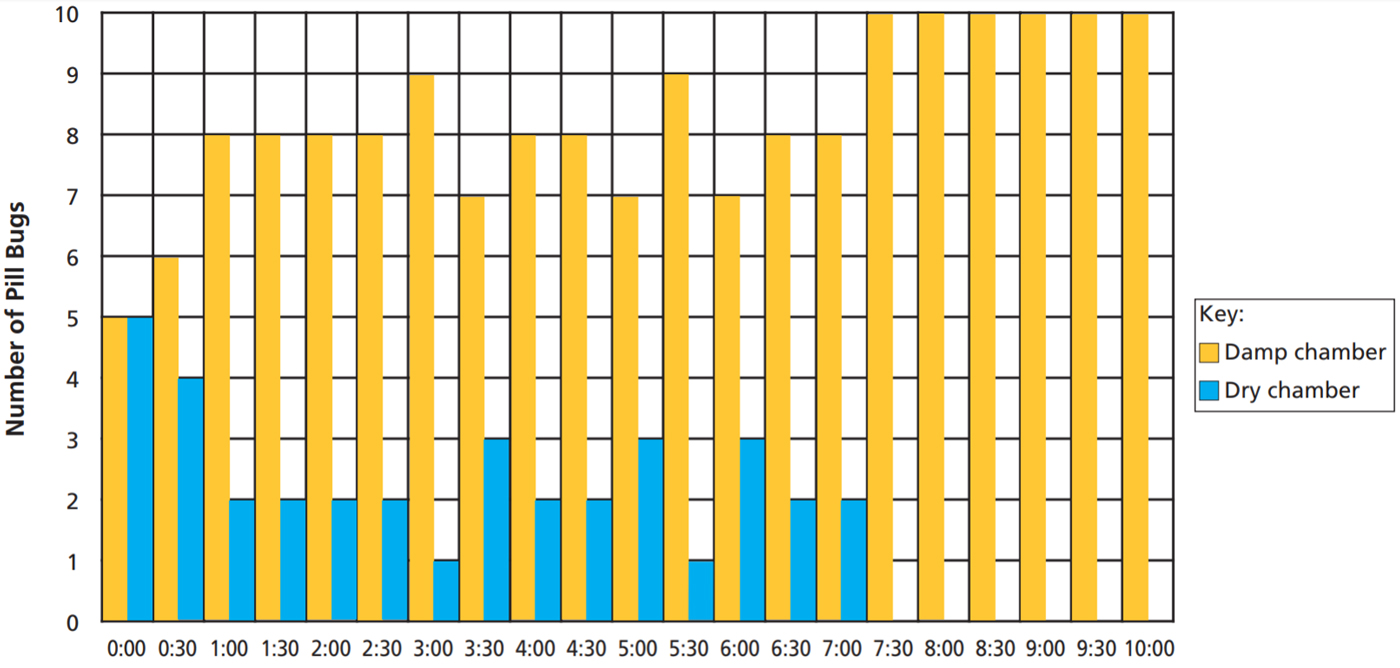
Graph your data for both the damp side and the dry side. Title the graph and supply the following information:
The independent variable is time.
The dependent variable is number of pill bugs.
Plot the independent variable on the x-axis, and the dependent variable on the y-axis.
Note: This graph is best done as a histogram, not as a line graph, because it is comparing two quantities and the data are discrete; for example, there may be 4 pill bugs or 5 pill bugs, but not 4.56 pill bugs. Constructing the graph by hand is tedious. It is best to enter the data into an electronic spreadsheet and generate a graph within the spreadsheet.
Get the latest news, free activities, teacher tips, product info, and more delivered to your inbox.