Ever wondered how it would feel to walk on water? Where humans have had only dreams, one group of aquatic insects has succeeded. For at least 30 million years, and possibly much longer, water striders, also known by their common names like pond skaters and water skippers, have skated across the surface waters of the world.
These insects, often referred to as true bugs, are assigned to the order Hemiptera, family Gerridae, which includes about 60 genera. Adults usually measure 3–20 mm and may be winged, short-winged, or wingless (Fig. I). Most of the genera live on the surface of freshwater streams, rivers, ponds, and lakes, where they carry out all their life functions (feeding, growing to adulthood, and mating). This family also includes the only insects known to live on the oceans, the Halobates, which have been discovered near shore and up to 2,000 miles from the nearest land.
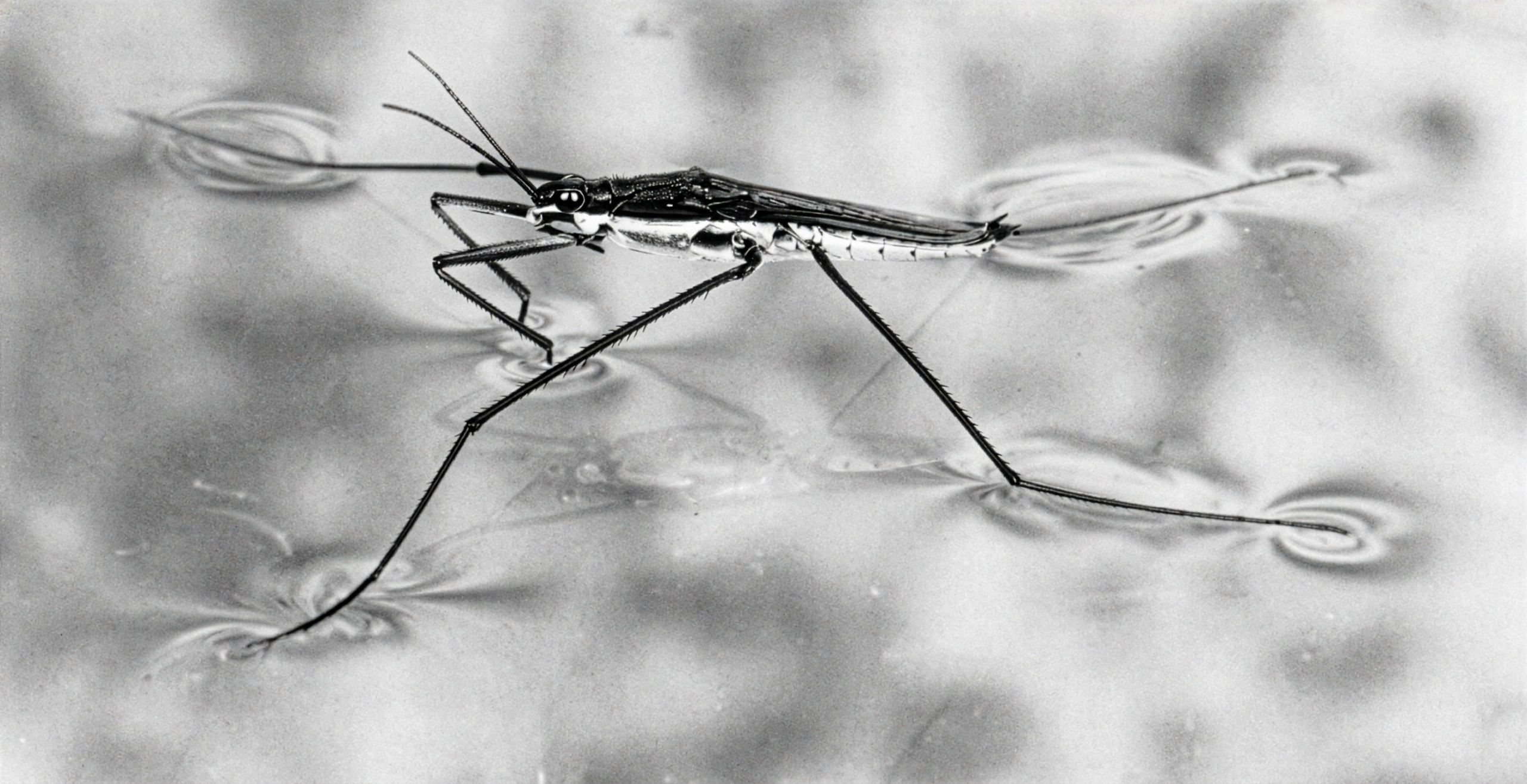
Simple principles of physics explain the evolutionary success of water striders. The insects exploit the surface tension of water, its viscosity, and buoyancy. Surface tension arises from the cohesive forces between the molecules of a liquid; it can make the surface of a liquid act as if it had an elastic membrane stretched over it. The strength of surface tension is one of the phenomena we all demonstrated ‘as elementary school children. Who can forget making a needle float on the surface of a glass of water? A water strider’s leg is not a needle, but it rides on the same surface.
A water strider breaks the water surface at only three times in its life: as a hatchling (eggs develop underwater) making an arduous journey to the surface; as a female egg-layer dipping her abdomen to deposit eggs underwater; and as an aged and dying adult taking on water (and weight) after losing its hydrophobic (water-repellent) properties.
Water striders can take advantage of the buoyancy of water because they are light and pubescent (hairy). The hairs repel water from their bodies. Hairs also increase the surface area and weight distribution across their legs. Lanna Cheng (1973) of the Scripps Institution of Oceanography demonstrated that ocean-dwelling species of gerrids, which are splashed constantly by rough seas, have even more hairs than the freshwater species.
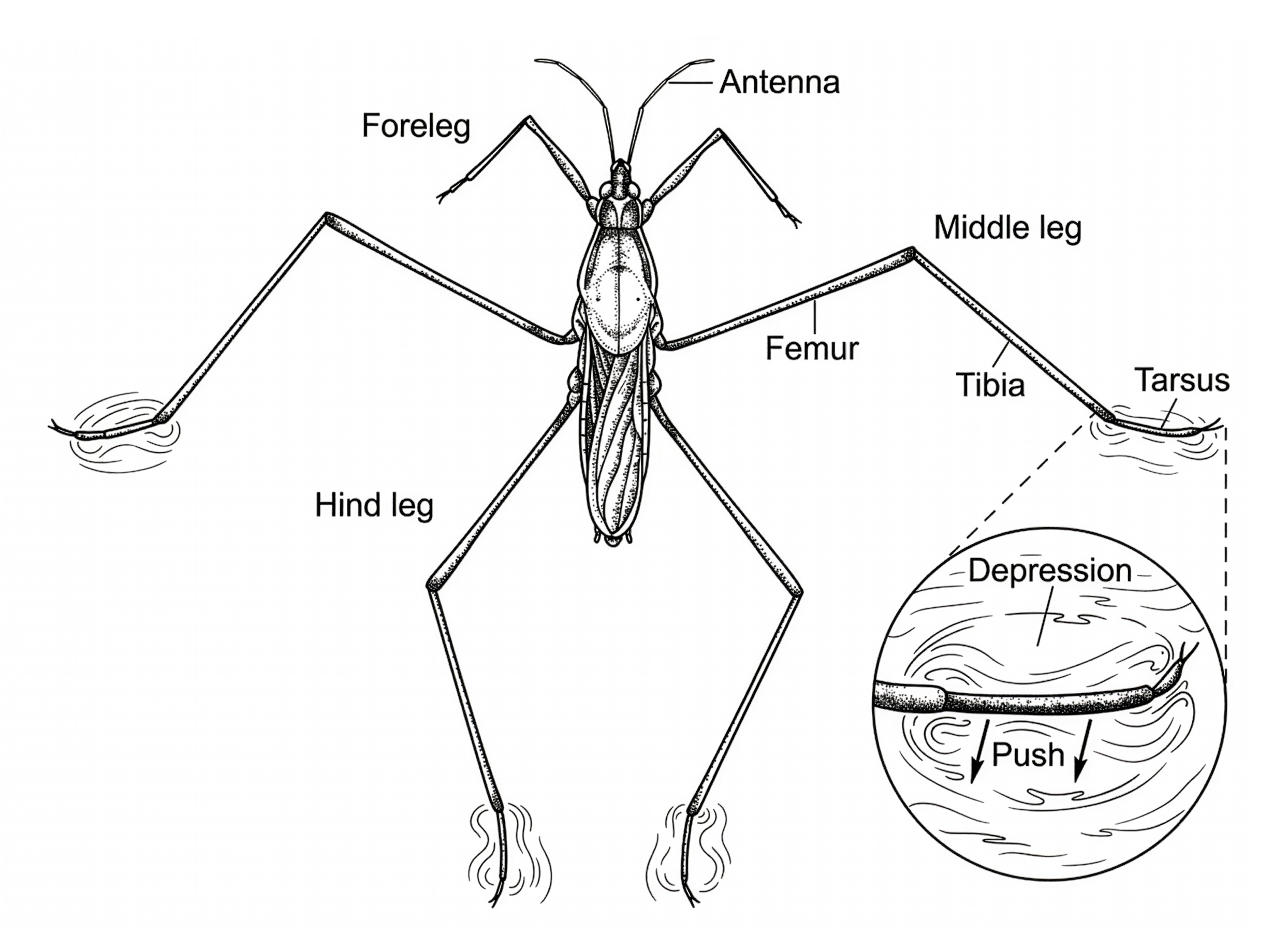
Striders have two types of movements: a slower, gliding motion used to move across the water and a quick jump, used to pounce on prey or to escape from a predator. Of the water strider’s three pairs of legs, the middle and hind legs work to propel it across the water (Fig. 2). The front pair, the forelegs, function primarily to manipulate food. The two longest parts of the water strider’s leg, the femur and the tibia, are analogous to the upper and lower leg, respectively, of humans, and the single or multiple-segmented tarsus at the end of each leg is roughly analogous to the human foot.
The middle legs function like oars and the hind legs like rudders, with the tibia of the hind legs lying flat on the water. A depression is formed in the water surface by each foot (Fig. 1, 2). The two middle legs of the strider move synchronously in a cranklike stroke (Bowdan, 1978). The strider’s leg movements that push it across the water are similar to the leg movements toddlers use to push themselves across the floor when straddling a four-wheeled ride-on toy. In the case of the water strider, of course, the surface tension of the water depression—and not a floor—provides the resistance.
Water striders feed on small insects that fall into the water. They also feed on insects that have an aquatic immature stage—e.g., mosquitoes, certain other flies. As the adults of such insects try to cross the surface to the air, water striders snatch them. Many water striders also cannibalize their own species, particularly their siblings.
The mouthparts of water striders match their vampirelike mode of feeding. These mouthparts are long and pointed and can pierce the tough exoskeleton of most insects. Although they look menacing, they cannot puncture human skin.
A water strider does not consume its prey. Holding its prey with its front legs, the strider first injects salivary enzymes that help to liquify the prey’s insides. Then the strider sucks out the body fluids of the creature it holds and discards the empty “shell” or exoskeleton. The meal of water striders is the “blood” (hemolymph) of the insect or other invertebrate.
When water striders mate, the female often continues to feed and glide. The smaller male rides on her back. While he grasps her midsection with his front legs, the tarsi of his middle legs continue to stroke the water, and his hind legs continue to function as rudders. The combined weight of the male and female is supported by side-by-side male and female legs.
Successful mating results in fertilized eggs. The female then deposits them on floating debris or on the undersides of aquatic vegetation. She dips the tip of her abdomen underwater to secure the eggs. Beyond that effort, there is no parental care.
When a tiny water strider hatches from an egg, it is underwater, unlike the larvae of some other insects. It has a limited reserve of oxygen to use while it brings itself topside. To right itself on the water, it uses its antennae and legs collectively as a spear to break a “hole” in the water surface and climb through it.
Water striders pass through five immature instar stages between egg and adult. Each successive instar looks a bit more like the adult. The change (metamorphosis) from immature to adult is gradual, and there is no resting or pupa stage as with butterflies.
With every passing stage of development and the molt (or shedding) of one “skin” and the formation of the next larger “skin,” there is a greater chance the insect will reach the adult stage. Even as an adult, however, the strider faces many aquatic predators, which include other insects, fish, and ducks. Water striders have adapted to predators over time. For example, striders can use both pairs of back legs to make quick jumps to escape. A more unpredictable threat is the loss of pristine habitats. For instance, water pollution often lowers surface tension and causes water striders to sink. Most species of water strider have an egg-to-adult life span of only 30 to 45 days.
Not all leg strokes move water striders. Surface wave communication in water striders has been recorded in literature for decades. To locate prey, most water striders seem to use a combination of visual and wave-ripple cues. In the early 1970s, Stimson Wilcox, working with Australian species belonging to the genus Rhagodotarsus, showed that striders communicate by generating water waves of different frequencies. The males he studied anchor themselves with their front legs and send out signals by creating ripples of water with their hind and middle legs. Since the early work of Wilcox, hundreds of other freshwater species have been shown to send out signals to attract mates and warn off predators as well as to locate prey. Legs also carry the receptors of wave signals.
The occurrence of the common North American water strider Gerris remigis has been recorded in every continental state. The good news about water striders is that it’s easy to rear them in the classroom. They require no more attention than common varieties of tropical fishes. If you have time to feed the striders once a day and to clean a water filter occasionally, you can observe all the stages of the water strider’s life cycle.
In early spring, adults return to the surface of the water—a good time to collect them since they begin to mate immediately. The simplest way to collect both a male and female of the same species is to collect a mating pair. Because the male rides on the female’s back when the two are mating, it’s as easy to collect a pair as it is to collect a single water strider.
Water striders have good vision. Capture them by bringing a suitable net up from underneath the surface of the water. If you try to scoop them from above the surface, they are very likely to see the net and skate away faster than you thought possible. Handle water striders with care when moving them from the net to a container. Gently grip their abdomens between an index finger and thumb. There is no danger to you; the insects do not bite or sting.
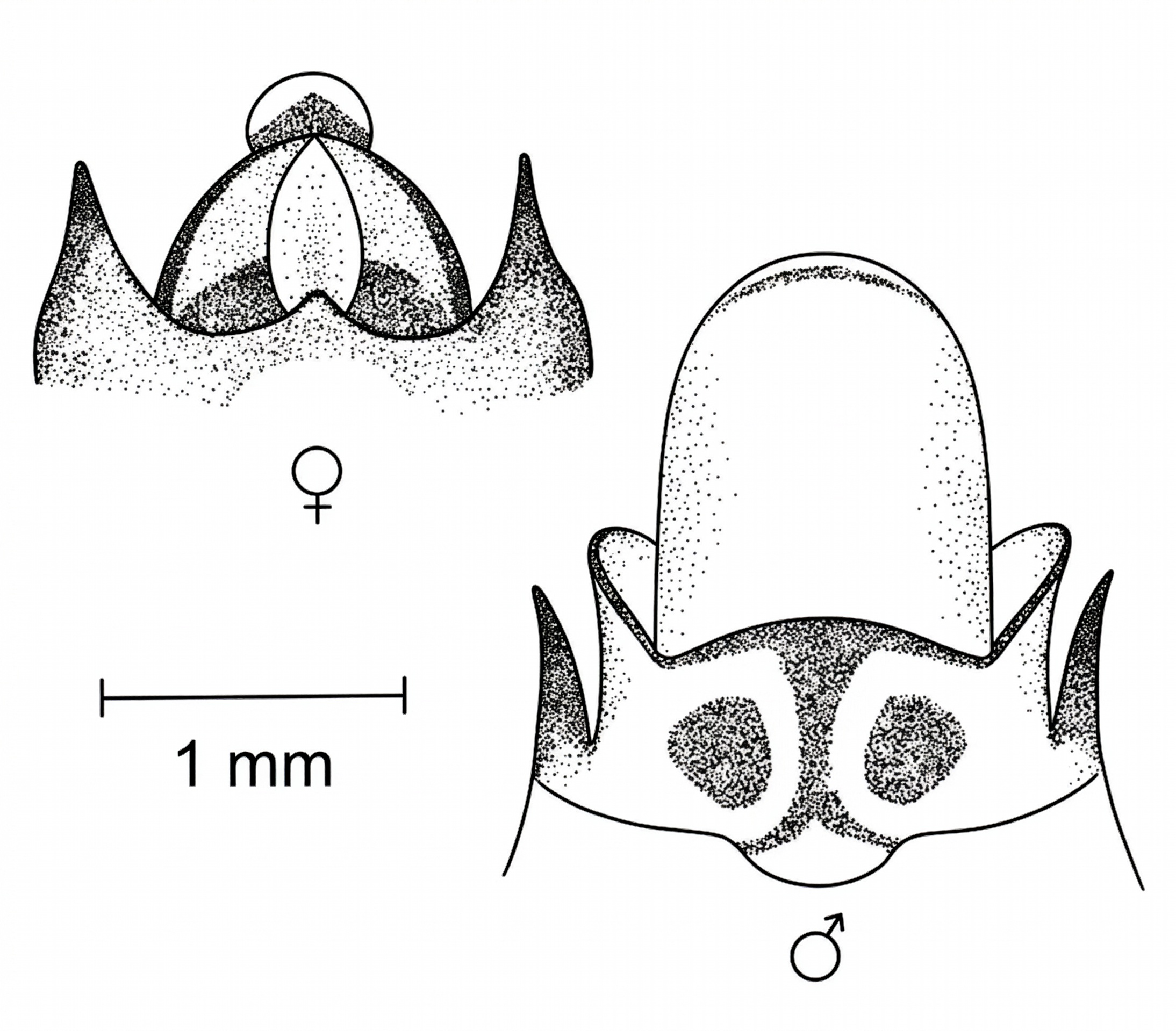
A hand lens will reveal the difference between males and females. The last segment of the female’s body has a slit in it on the under (ventral) side: the exit for eggs (Fig. 3). In most species of gerrids, males are smaller than females.
Whether you collect water striders or obtain them from Carolina, you should consider how many you can accommodate in the classroom. In general, one mating pair should have about one gallon of water; a clear plastic crisper is a perfect size for a single pair. Four to six adults in a 10-gallon aquarium filled to a depth of 8 inches with water is also suitable. The container must have a top, a screen, or a piece of plastic with some small air holes to prevent water striders from climbing or flying out. Adding an aquarium filter keeps the water aerated and circulating and helps prevent the water from being fouled by bacteria. Unless your tap water is treated with softeners, it should be suitable for classroom use. If distilled water is available, it’s the best choice.
Pieces of cork or Styrofoam® make good egg-laying sites for classroom-reared water striders. However, females will deposit eggs on the undersides of almost anything that floats on the water. Each female will deposit between 20 and 40 eggs. The eggs are 1-2 mm long and visible with the unaided eye. If the water temperature is maintained between 21 and 24° C, bright red eyespots will form at one end of each egg within two days after the eggs are deposited. In about seven days, the first nymphal stage of the water strider will emerge from the egg.
Vestigial winged Drosophila make excellent food for all stages of water strider development. Of course, a first-stage water strider is much smaller than the fruit fly, and a number of the nymphs will feed on the same fly. Provide the first- and second-stage nymphs one fruit fly per three water striders each day. Provide the third-stage nymphs one fly each. In stages four, five, and adult, provide three flies for each strider.
An adult female usually dies shortly after she deposits all her eggs. The male sometimes lives a bit longer. Even well-fed water striders sometimes become cannibalistic, and for that reason, you should remove any living adults from your rearing container before eggs hatch.
This article was originally published in Carolina Tips®, Vol. 53, No. 12 (print version, December 1990); it was revised May 2026.
Further Reading
Andersen, N. M. (1982). The semiaquatic bugs (Hemiptera, Gerromorpha): Phylogeny, adaptations, biogeography and classification. Entomogroph. Scandinavian Press.
Bowdan, E. (1978). Walking and rowing in the water strider, Gerris remigis I: A cinematographic analysis of walking. Journal of Comparative Physiology, 123, 43-49.
Calabrese, D. M. (1980). The zoogeography and a cladistic analysis of the Gerridae (Hemiptera: Heteroptera). Miscellaneous Publications of the Entomological Society of America, 11, 1-119.
Cheng, L. (1973). Marine and freshwater skaters: Differences in surface fine structures. Nature, 242, 132-133.
Murphey, R. (1971). The water strider’s response to prey. Fauna, 3, 33-36.
Updated Research
Ma, J. Z., Lu, H. Y., Li, X. S., & Tian, Y. (2020). Interfacial phenomena of water striders on water surfaces: A review from biology to biomechanics. Zoological Research, 41(3), 231-246. https://doi.org/10.24272/j.issn.2095-8137.2020.029
Florida Poly professor uncovers secrets of water-walking insects’ survival
Missouri Department of Conservation: Water Strider Field Guide
Diane M. Calabrese, Ph.D.
22 Anderson Avenue,
Columbia, Missouri 65203-2673
Get the latest news, free activities, teacher tips, product info, and more delivered to your inbox.