
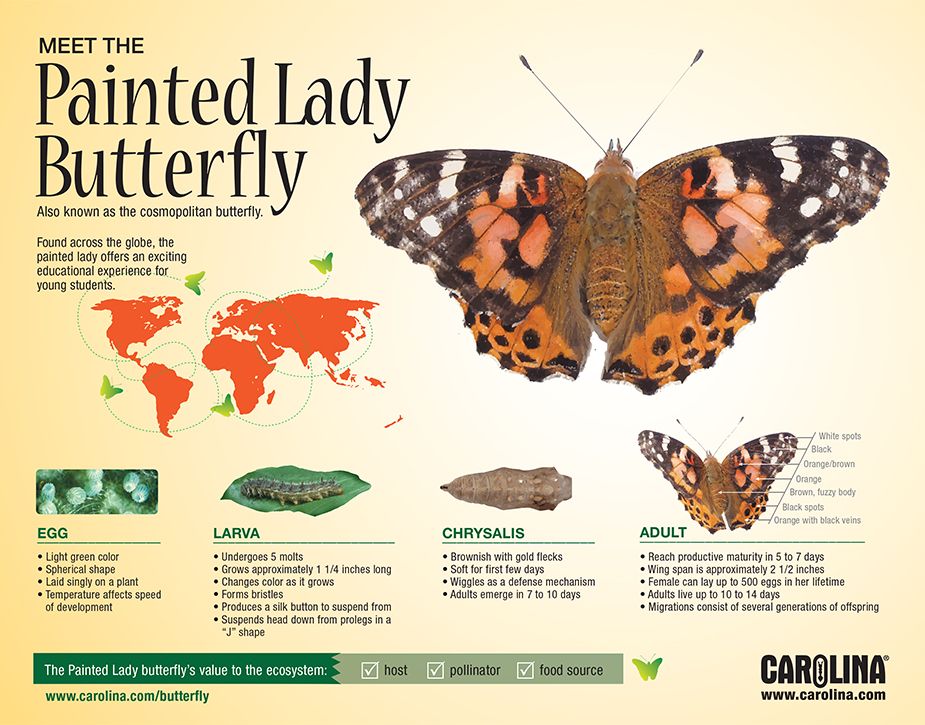
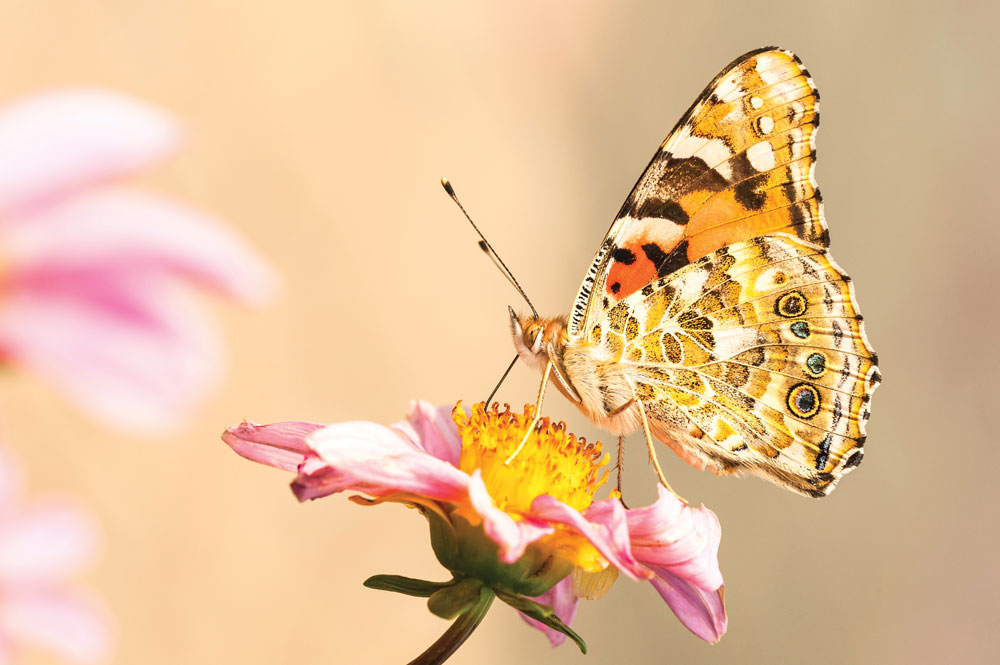
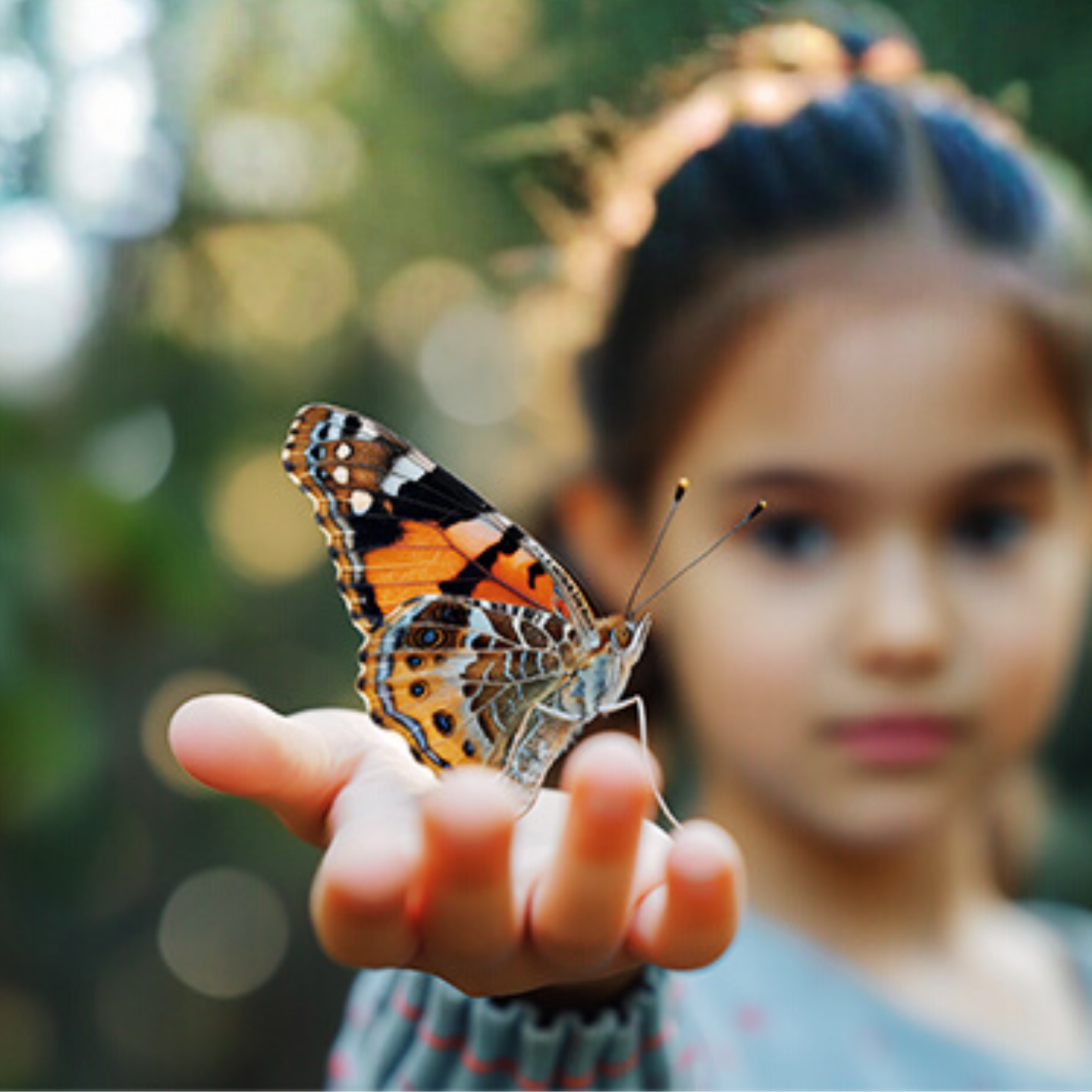
The painted lady butterfly (Vanessa cardui), commonly found throughout North America in open deserts, fields, and roadsides, is one of the most popular insects for classrooms. It is frequently referred to as the “cosmopolitan” because of its wide distribution.
In this article, we’ll discuss the painted lady’s life cycle and care and feeding. You’ll see how easy it is to care for these beautiful insects and perhaps begin to form some creative ideas about how they can be used to address the topics above. Hands-on activities and research projects involving these butterflies can be used to address the following topics:
- The miracle of metamorphosis
- How organisms rely on their environment
- Differences in animal life cycles
- How form fits function
- Interdependence of organisms
- Butterfly conservation
- Human impact on nature
Painted lady life cycle
Females may lay eggs 5 to 7 days after emerging as adults. Look for pinhead-sized, mint green dots. Fertile eggs hatch in about 3 days. From the eggs, larvae will emerge and constantly eat for 5 to 10 days before pupating (forming chrysalises). Adults emerge from chrysalises in 7 to 10 days.
Care and feeding
Butterfly kits for your classroom
Carolina offers butterfly kits to fit your classroom needs. Our Butterflies in the Classroom Kits come with everything you need to successfully raise painted lady butterflies from larvae to adults and engage your students in the process of metamorphosis. The teacher’s manual will lighten your planning load, as it includes a variety of activity ideas for incorporating butterfly studies into your curriculum.
The Painted Lady Butterfly Amazing Bugsâ„¢ Kit is an interactive kit that provides your students with hands-on activities that highlight the butterfly’s life cycle, behavior, and biology. Additionally, when you buy the Amazing Bugsâ„¢ Kit, you make a donation to purchase and protect one acre of threatened habitat.
The wide-ranging painted lady butterfly is one of the most popular insects for classrooms. We’ve seen how easy it is to raise them, especially with our kits, and the many topics that you can address with them. You and your students can now develop creative ways to use butterflies to address those topics. For more information on painted lady butterflies and to purchase kits and components, visit www.carolina.com/butterflies or see our latest Carolinaâ„¢ Science catalog.
Add a colorful twist to your students’learning experience-with Carolina’s painted lady butterflies!
Butterfly Resources
Butterflies
Learn about painted ladies in the larval, pupal, and adult stages, with emphasis on the larval stage. This guide covers maintenance, care, and feeding, along with activities and some...
Butterwalkers
Every spring Carolina ships thousands of boxes of butterfly larvae all over the country. Most of those larvae become butterflies with no issues, but every once in a while,...
Comparative Metamorphosis
A CAROLINA ESSENTIALS INVESTIGATION Total Time Prep: 30 mins Activity: 20-30 mins Life Science Grade Level 5-8 Elementary/Middle School Quick Links Close Quick Links Open Quick Links Introduction Essential...
Which Leaf Shape Can Hold the Most Butterfly Eggs?
A CAROLINA ESSENTIALS ACTIVITY Total Time Prep: 30 mins Activity: 30 mins Life Science Grade Level K-5 Elementary School Quick Links Close Quick Links Open Quick Links Overview Essential...
Butterfly Necklace
In Booth Demo Life Science K-12 Elementary / High School Students gain an understanding of the life cycle of the painted lady butterfly. They observe the growth and development...
Bees, Butterflies, and Flowers
Background Spring’s arrival is marked by days that start to grow longer, temperatures that begin to rise, and the many plants that awake from their winter sleep. Certain species...
About The Author
Carolina Staff
Carolina is teamed with teachers and continually provides valuable resources–articles, activities, and how-to videos–to help teachers in their classroom.