Carolina offers many types of premade solutions, but some teachers prefer to make their own. If that is your interest, keep reading. This brief guide will provide you with the information you need to make a number of solutions commonly used in educational laboratories.
Let’s review some safety considerations:
- Always wear appropriate personal protective equipment (PPE) when handling chemicals and preparing solutions. Use this guide to choose the PPE that is right for your needs.
- Read a chemical’s label twice before use. Read it when you take the chemical off the shelf and again before you remove any chemical from the bottle.
- When using concentrated chemicals to prepare solutions, be sure you slowly add the more concentrated solution to the less concentrated one. The reverse procedure can cause the solution to boil and spatter.
Dilutions
When preparing a dilution, decide the volume and molar concentration of the resulting solution you require. Use the following equation to determine how much of the concentrated reagent is needed to prepare the diluted solution,
Mreagent × Vreagent = Mdilution × Vdilution
where M is molarity and V is volume.
Slowly add the calculated volume of concentrated reagent to the proper-size volumetric flask half filled with distilled or deionized water and swirl the flask to mix. Once the solution is at room temperature, dilute to the mark with water, insert and secure the stopper, and invert the flask several times to mix.
For example, what volume of 10 M acetic acid is required to prepare 1.0 L of 0.50 M acetic acid?
10 M × Vreagent = 0.50 M × 1.0 L
Vreagent = 0.050 L = 50 mL
A volume of 50 mL of 10 M acetic acid is required to prepare 1.0 L of 0.50 M acetic acid.
Recipes for common solutions
To prepare these solutions, slowly add the necessary ingredients to a 1-L volumetric flask half filled with distilled or deionized water. Allow the ingredients to dissolve completely, swirling the flask gently if necessary. Once the solute is completely dissolved and the solution is at room temperature, dilute to the mark with water. Insert and secure the stopper and invert the flask several times to mix.
Each reagent in the following chart is linked to our online catalog for additional information and convenient purchase. For the liquids, we have referenced the 500-mL size of the reagent- or ACS-grade chemical packaged in a plastic-coated safety bottle. For sodium hydroxide, we have listed the 500-g size of the reagent-grade chemical. Other sizes and grades may be available. Please consult our catalogs for more information.
| Initial Reagent | Quantity to add to water to make 1 L | Final Concentration |
|---|---|---|
|
5.7 mL acetic acid |
0.1 M |
|
|
|
57 mL acetic acid |
1 M |
|
8.3 mL hydrochloric acid |
0.1 M |
|
|
|
83 mL hydrochloric acid |
1 M |
|
|
248 mL hydrochloric acid |
3 M |
|
|
496 mL hydrochloric acid |
6 M |
|
4 g sodium hydroxide |
0.1 M |
|
|
|
40 g sodium hydroxide |
1 M |
|
56 mL sulfuric acid |
1 M |
|
|
|
5.6 mL sulfuric acid |
0.1 M |
Whether you decide to make your own solutions or buy them from us premade, you’ll find everything you need at Carolina.
Molar solutions
Molarity (M) means the number of moles of solute per liter of solution. To prepare a 1 M solution, slowly add 1 formula weight of compound to a clean 1-L volumetric flask half filled with distilled or deionized water. Allow the compound to dissolve completely, swirling the flask gently if necessary. Once the solute is completely dissolved and the solution is at room temperature, dilute to the mark with water. Insert the stopper, and with your thumb on the stopper and hand on the neck of the flask,. invert the flask several times to mix. Here are a couple of examples of how to use this method:
- To make a 1 M solution of sodium hydroxide, slowly add 40 g sodium hydroxide to 500 mL distilled or deionized water in a 1-L volumetric flask. When the solids are completely dissolved and the solution is at room temperature, dilute to the mark, insert and secure the stopper with your thumb, and invert the flask several times to mix.
- To make a 1 M solution of acetic acid, dissolve 60.05 g acetic acid in 500 mL distilled or deionized water in a 1-L volumetric flask. Because acetic acid is a liquid, the acid may also be measured by volume. Divide the mass of acid by its density (1.049 g/mL) to determine the volume (57.24 mL). Use either 60.05 g or 57.24 mL acetic acid to make the solution. Swirl the flask gently to mix the solution. When the solution is at room temperature, dilute to the mark, insert and secure the stopper with your thumb, and invert the flask several times to mix.
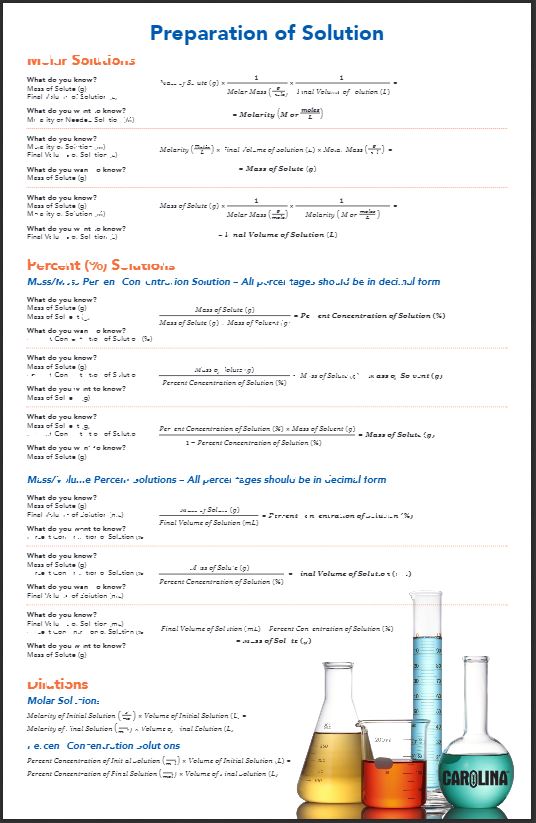
Frequently Asked Questions About Solution Preparation
How do I make ___ mL of a ___ molar solution?
Ex: How do I make 100 mL of a 3M aqueous sodium hydroxide solution?
Determine molarity required: M = 3M solution = 3 moles NaOH/1 L of solution
Determine molar mass: MM of NaOH = 40 g/mol
Convert volume required to liters: V = 100 mL x 1 L/1000 mL = 0.1 L
Grams required = V x M x MMNaOH
0.1 L soln x 3 moles NaOH/1 L soln x 40 g NaOH/1 mole NaOH = 12 g NaOH
Prepare the solution:
- Select a 100-mL flask, preferably volumetric.
- Weigh out 12 grams of sodium hydroxide.
- Fill flask about half full with deionized or distilled water.
- Add sodium hydroxide to the flask.
- Mix until dissolved using a stirring bar and stir plate or by swirling gently.
- Add water up to the 100-mL volume mark on the glassware and mix again.
How do I dilute a solution?
Ex: How do I make a 500-mL solution of 3M HCl acid from 12 M HCl acid?
M1= Initial Molarity = 12 M
V1= Initial Volume = ?
M2= Final Molarity = 3 M
V2= Final Volume = 500 mL
Calculate the volume of initial solution necessary for the dilution:
M1V1 = M2V2
(12 M)(V1) = (3 M)(500 mL)
V1 = 125 mL
125 mL of 12 M HCl acid is required to make 500 mL of 3 M HCl acid.
Prepare the solution:
Using a 500-mL volumetric flask and graduated cylinder, add 125 mL of concentrated acid to 250 mL of water. Make sure to stir slowly and then add remaining water to reach a final volume of 500 mL.
Note: If you need to prepare a very dilute solution from a stock solution, you may need to perform more than one dilution. By creating a more manageable and less concentrated solution, the final molarity will be more accurate. See our infographic on performing serial dilutions.
How do I convert to molarity from a percent concentration?
Ex: What is the molarity of a 10% potassium hydroxide solution?
100 mL of 10% KOH solution contains 10 g of potassium hydroxide.
MM of KOH = 56 g/mol
10 g KOH x 1 mol KOH/56 g KOH = 0.18 moles KOH
0.18 moles KOH/100 mL soln x 1000 mL soln/1 L soln = 1.8 moles KOH/L of soln = 1.8 M soln
How do I make ___ mL of a ___ molar solution?
Ex: How do I make 100 mL of a 3M aqueous sodium hydroxide solution?
Determine molarity required: M = 3M solution = 3 moles NaOH/1 L of solution
Determine molar mass: MM of NaOH = 40 g/mol
Convert volume required to liters: V = 100 mL x 1 L/1000 mL = 0.1 L
Grams required = V x M x MMNaOH
0.1 L soln x 3 moles NaOH/1 L soln x 40 g NaOH/1 mole NaOH = 12 g NaOH
Prepare the solution:
- Select a 100-mL flask, preferably volumetric.
- Weigh out 12 grams of sodium hydroxide.
- Fill flask about half full with deionized or distilled water.
- Add sodium hydroxide to the flask.
- Mix until dissolved using a stirring bar and stir plate or by swirling gently.
- Add water up to the 100-mL volume mark on the glassware and mix again.
How do I dilute a solution?
Ex: How do I make a 500-mL solution of 3M HCl acid from 12 M HCl acid?
M1= Initial Molarity = 12 M
V1= Initial Volume = ?
M2= Final Molarity = 3 M
V2= Final Volume = 500 mL
Calculate the volume of initial solution necessary for the dilution:
M1V1 = M2V2
(12 M)(V1) = (3 M)(500 mL)
V1 = 125 mL
125 mL of 12 M HCl acid is required to make 500 mL of 3 M HCl acid.
Prepare the solution:
Using a 500-mL volumetric flask and graduated cylinder, add 125 mL of concentrated acid to 250 mL of water. Make sure to stir slowly and then add remaining water to reach a final volume of 500 mL.
Note: If you need to prepare a very dilute solution from a stock solution, you may need to perform more than one dilution. By creating a more manageable and less concentrated solution, the final molarity will be more accurate. See our infographic on performing serial dilutions.
How do I convert to molarity from a percent concentration?
Ex: What is the molarity of a 10% potassium hydroxide solution?
100 mL of 10% KOH solution contains 10 g of potassium hydroxide.
MM of KOH = 56 g/mol
10 g KOH x 1 mol KOH/56 g KOH = 0.18 moles KOH
0.18 moles KOH/100 mL soln x 1000 mL soln/1 L soln = 1.8 moles KOH/L of soln = 1.8 M soln
Teacher Tips
- Hydrates
Consider the formula weight of hydrates when calculating the concentration of solutions. The formula weight of hydrates will be higher due to the additional molecules of water. The attached water molecules contribute water to the final solution.
- Always add acid to water—never the reverse.
Mixing strong acids and water causes an exothermic reaction. If you add water to acid, you form a very concentrated acid initially. The reaction gives off so much heat that the solution could boil out of the container. When you add acid to water, the solution slowly becomes more concentrated. If it does splatter, there will be more water and less chance of contact with acid. - Stock Solutions
Keeping stock solutions can conserve money and space! If needed, a stock solution can easily be diluted into a working solution of a desired concentration. Carolina offers a large variety of chemical grades, sizes, and concentrations. - Personal Protective Equipment
Always use proper personal protective equipment (PPE) when working with chemicals. Refer to SDS for safe usage, storage, and handling instructions. Common PPE for the lab includes:- Safety glasses or goggles
- Lab coats and aprons
- Gloves (based on material handled)
- Face shield
- Distilled or deionized?
Deionized water has been treated to remove inorganic charged particles (ions). The process does not remove molecules or biological contaminants.
Distilled water is free of almost all inorganic minerals, chemicals, and biological contaminants.
For most laboratory applications, deionized water is sufficient.