



A CAROLINA ESSENTIALS INVESTIGATION

Modeling Alpha and Beta Decay

Time Icon

Total Time

Physical Science

grade icon

Grade Level

9-12 High School

Introduction

Students often use balanced nuclear reactions to model changes that occur in an unstable nucleus, but that doesn’t help students assess why the nucleus is unstable initially. In this activity, students use the band of stability and neutron-proton ratios to construct a simple predictive model to determine if an isotope will decay or not decay, and if the isotope does decay, whether the process is more likely to be alpha or beta decay. The activity does not address positron emission and gamma radiation.

Students calculate neutron-proton ratios for selected isotopes, determine if the isotope is stable or unstable, find the isotope’s location on the band of stability to determine decay type, and then write balanced nuclear equations for the isotopes that decay.

Phenomenon

Nuclear medicine is a branch of medicine that relies on the proper selection of radioactive isotopes to produce scans like those above and to treat many types of cancer. Why do you think nuclear decay can be a powerful and useful medical tool? Discuss responses with your students. Some students may have personal experience with diagnostic tools or treatment.

Essential Question

How can changes in the composition of the nucleus of an atom be predicted and modeled?

Investigation Objectives:

  1. Determine if an isotope is stable or unstable.
  2. Construct a model that predicts the type of nuclear decay expected for unstable nuclei.

Next Generation Science Standards* (NGSS)

HS-PS1-8. Develop models to illustrate the changes in the composition of the nucleus of the atom and the energy released during the process of fission, fusion, and radioactive decay.

SCIENCE & ENGINEERING PRACTICES

Developing and Using Models

DISCIPLINARY CORE IDEA

PS1.C: Nuclear Processes

CROSSCUTTING CONCEPTS

Energy and Matter

Materials Needed

Recommended Safety

No PPE is required for the activity.

Teacher Prep and Disposal

Copy the student pages or upload them to a class web page.

 
Student Procedures
  1. Review isotope notation with students so they recall that the top number is mass and the bottom number is charge (protons) for a block representation, and mass is the number following the element name in the long-hand notation.
  2. For this activity, round all calculations to 2 decimal places.
  3. Review the band of stability chart with students. Each small block represents a different isotope. Point out that isotopes of the same element may decay through different processes.
  4. Remind students that a balanced nuclear equation shows conservation of charge and mass. The top numbers (mass) on both sides of the arrow must be equal, and the bottom numbers (charge) on both sides of the arrow must be equal. Use the charge to identify the daughter nuclide.
  5. An interesting extension project is to assign students one of the imaging isotopes or treatment isotopes for additional research. Include how the isotope is made, how it is used or administered, and what specific diseases it is used to treat.
Teacher Preparation and Tips
  1. Have students remove soil from the plant roots before beginning.
  2. Encourage students to write their observations on the paper.
  3. Emphasize the difference in overall shape between the plants.
  4. Emphasize form and function.

Data and Observations

Data Table

radiation data and observations table


Band of Stability

band of stability diagram

Source: Wikimedia Commons. Table isotopes en.svg.


Balanced Nuclear Equations

balanced nuclear equations


Analysis and Discussion

Analysis and Discussion

Construct a process diagram or flow chart that can be used to identify an isotope’s stability, and if unstable, how it will decay.
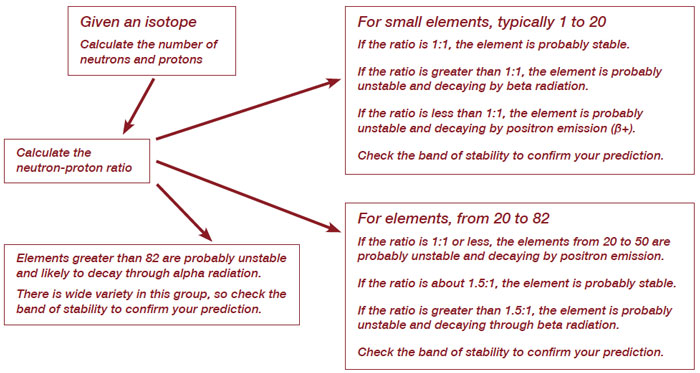
process diagram of an isotope's stability

Your teacher will assign you a medical isotope. Use your model to determine if the isotope is stable or unstable, and if unstable, how it will decay. Write the balanced nuclear equation for the decay of the isotope.

Student answers will vary. Use the chart from the National Isotope Development Center (NIDC) to assign elements, and check to see that students follow their flow charts.
Exploring Density Kit image
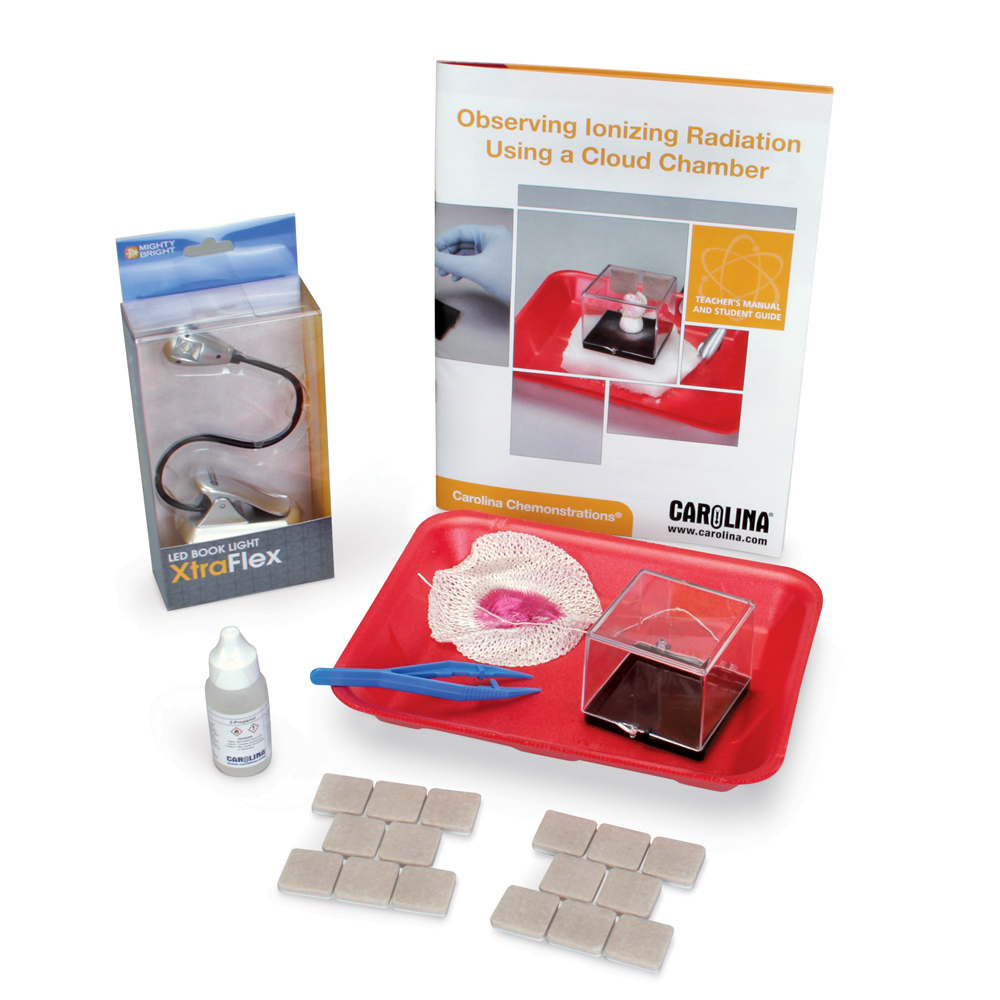
840374 Observing Ionizing Radiation Using a Cloud Chamber

Buy the Kit

Students experience the phenomenon of radioactive decay through observing tracks created in a cloud chamber by ionizing radiation as it passes through a cooled, supersaturated alcohol vapor.

*Next Generation Science Standards® is a registered trademark of Achieve. Neither Achieve nor the lead states and partners that developed the Next Generation Science Standards were involved in the production of this product, and do not endorse it.

About The Author

Newsletter Signup

Get the latest news, free activities, teacher tips, product info, and more delivered to your inbox.