



9-12 High School
Understanding the relationships between biotic diversity and abiotic factors in an ecosystem can be a difficult task. Using soil invertebrates, students can identify both the number of species present in a soil sample and the number of individuals within a species. With some simple math, a measure of biodiversity and effective number of species can be calculated. This information can be compared to soil pH, moisture, and temperature to develop an ecosystem model. Students construct a simple and inexpensive Berlese funnel to collect and identify soil invertebrates.
How do abiotic factors influence the biodiversity and density of soil invertebrates?
Constructing Explanations
LS2 Ecosystems: Interactions, Energy, and Dynamics ESS2 Earth’s Systems
Patterns
Remind students to use scissors properly. Identify students who may have allergies to bug bites, insect stings, plants, or pollen. Take necessary precautions.
Return excess soil outside. Once invertebrates are identified, flush alcohol down the sink with water. Dispose of invertebrates in the trash.
Berlese Funnel Construction
Making the Berlese Funnel
Abiotic Soil Properties
Invertebrate Inventory
| Temperature (C°) | pH | Moisture Initial Mass (g) | Final Mass (g) | Water Mass (g) |
|---|---|---|---|---|
| Student answers will vary. | ||||
| Species | Class | Number (n) |
|---|---|---|
| Typical invertebrates may include ants, mites, spiders, springtails, termites, and centipedes. | ||
1.Calculate the percentage of soil moisture.
% soil moisture = (water mass/final dry mass) × 100
2. Calculate invertebrate density.
Density = total number of invertebrates/area (50 cm × 50 cm)
3. Calculate the Simpson Index of Diversity.
Ds = 1 – [Σni(ni –1)/N(N – 1)]
4. Compare group results and discuss differences in invertebrate samples, locations, biodiversity, and abiotic factors.
Answers will vary.
5. What patterns can be established between biotic and abiotic factors?
Temperature and moisture should affect the number and type of soil invertebrates.
6. How would the season of the year impact biotic and abiotic factors?
As seasons change, temperature and precipitation amounts change.
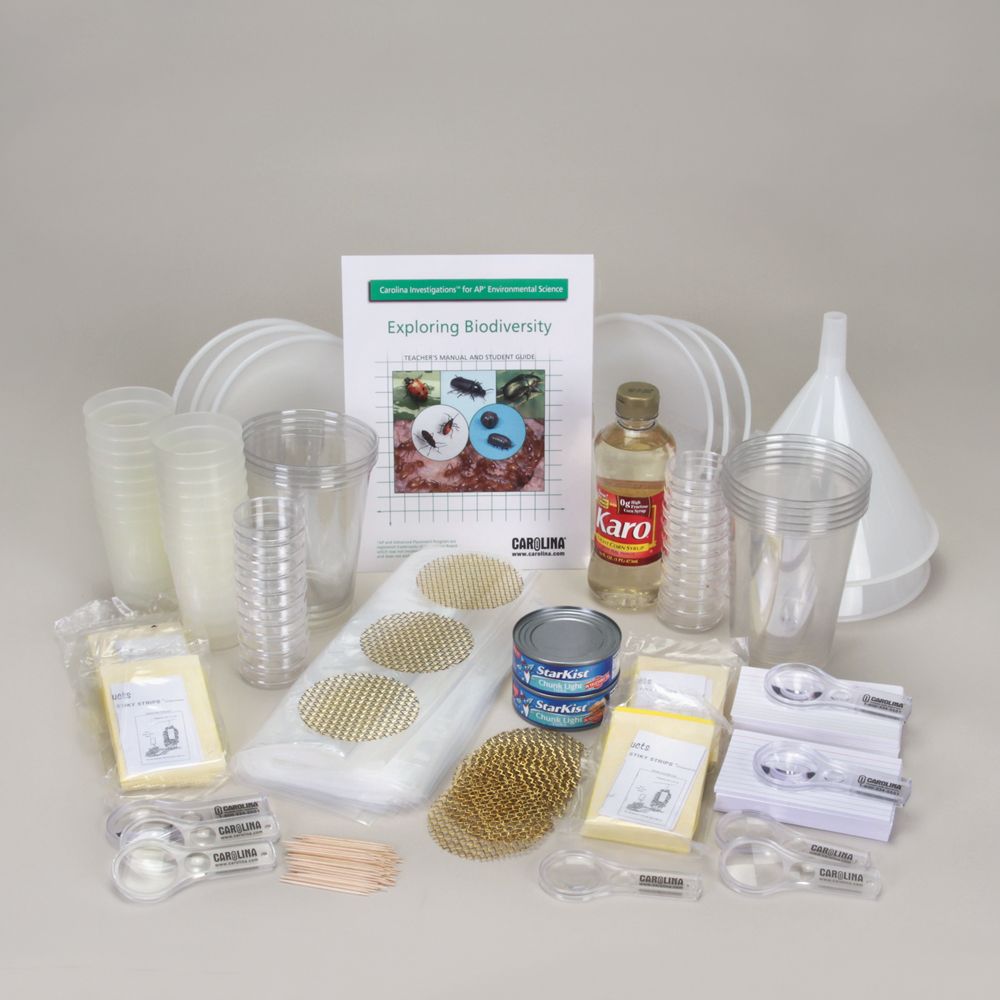
This kit provides 3 different labs to demonstrate various methods to collect and evaluate invertebrate diversity.
*Next Generation Science Standards® is a registered trademark of Achieve. Neither Achieve nor the lead states and partners that developed the Next Generation Science Standards were involved in the production of this product, and do not endorse it.

Carolina is teamed with teachers and continually provides valuable resources–articles, activities, and how-to videos–to help teachers in their classroom.
Get the latest news, free activities, teacher tips, product info, and more delivered to your inbox.