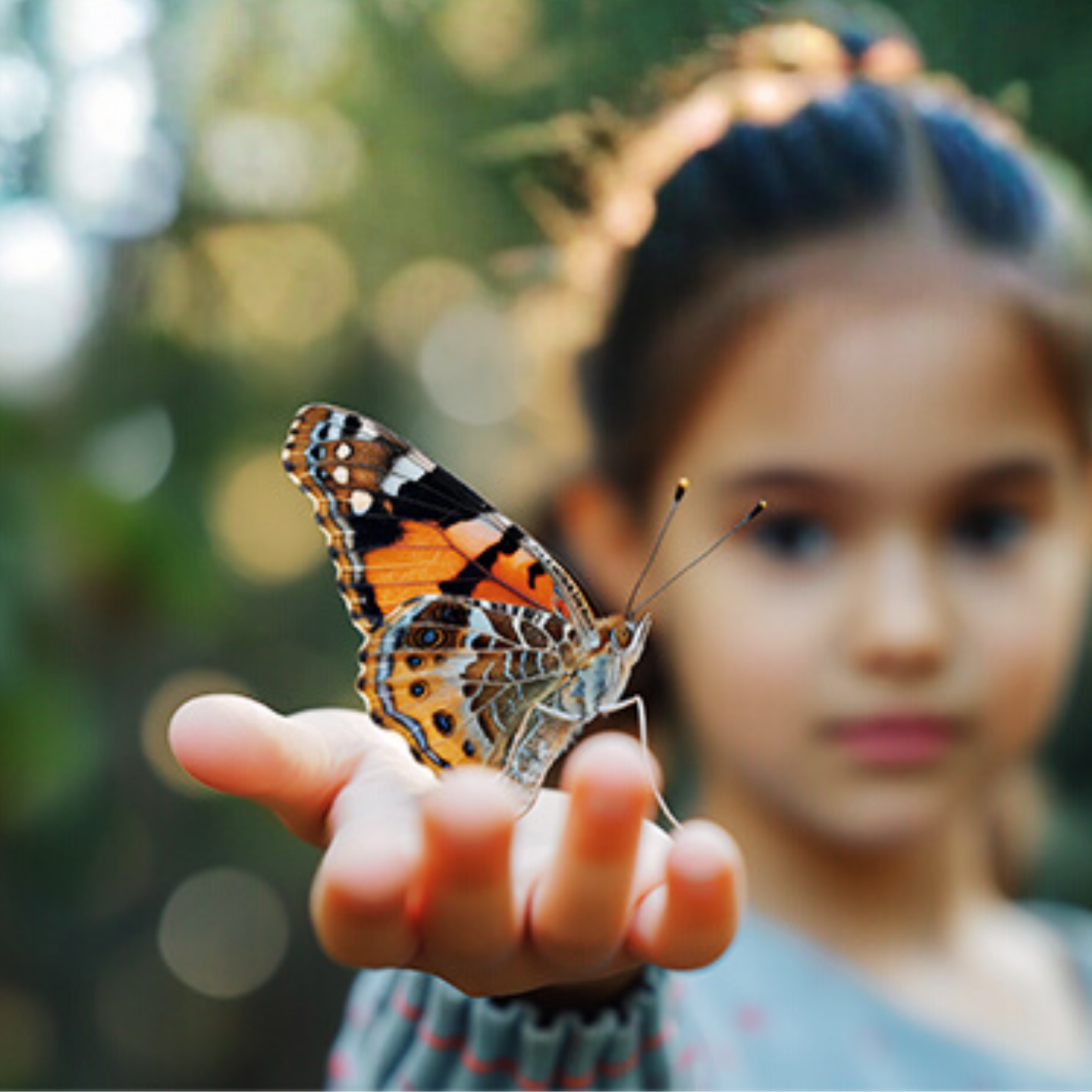

Beetles are excellent organisms for science teachers because they’re abundant, diverse, and easy for students to observe. As members of the order Coleoptera, beetles make up one of the largest groups of animals on Earth, with hundreds of thousands of described species worldwide and thousands found across North America. A classroom study of beetles can help students practice observation, compare body structures, and understand how insects grow and change over time. Whether students encounter a lady beetle in the garden or a darkling beetle in a life cycle kit, beetles offer a clear introduction to insect biology.
Like all insects, beetles have three main body regions: head, thorax, and abdomen. The head contains the antennae, compound eyes, and mouthparts. Beetle antennae are important sensory structures that help detect odors, vibrations, and chemicals in the environment. Their mandibles, or jaws, are usually adapted for biting and chewing, which is useful for feeding on leaves, wood, fungi, seeds, or even other insects. The thorax is the middle region and holds the three pairs of jointed legs and at least one pair of wings. In most beetles, it also supports two pairs of wings. The most recognizable feature of beetle anatomy is the pair of hardened forewings called elytra. These wing covers protect the softer hind wings and the abdomen beneath them. When a beetle flies, the elytra lift and the folded hind wings unfold. The abdomen contains many internal organs involved in digestion, respiration, and reproduction.
One reason beetles are so useful in teaching is that students can easily compare adaptations. While all beetles share the same general body plan, different species show visible differences in antenna shape, leg structure, body form, and color. Ground beetles often have long legs suited for running. Scarab beetles may have strong front legs for digging. Weevils are known for their elongated snouts, while some longhorn beetles have exceptionally long antennae. These differences help students connect structure to function and see how body parts support survival in specific habitats.
Science teachers can introduce students to several common and familiar beetle groups. Lady beetles, often called ladybugs or ladybird beetles, are among the best known and are useful examples of beneficial predators because many feed on aphids, while other beetle species serve as a scavenger or important pollinators. Ground beetles are another important group; they are usually fast-moving predators, like the agile tiger beetle, found under rocks, logs, or leaf litter. Scarab beetles, members of the family Scarabaeidae, include June beetles, the impressive rhinoceros beetle, and dung beetles, which are helpful for showing how beetles can act as recyclers in ecosystems. Weevils provide a good example of plant-feeding beetles and are easy to identify by their snouts, though some species like the bark beetle or the potato beetle are managed in agriculture without using pesticide. Fireflies, which many students do not realize are beetles, are especially engaging because of their ability to produce light. Darkling beetles are also common in classrooms because their larvae, known as mealworms, are frequently used in life cycle studies.
Beetles undergo complete metamorphosis, passing through four distinct life stages: egg, larva, pupa, and adult. The cycle begins when a female lays eggs in or near a suitable food source. After hatching, the larva emerges. Beetle larvae often look very different from the adults and may appear wormlike or grub-like. At this stage, their main job is to eat, grow, and store energy. Many larvae molt several times as they increase in size. When the larva has developed enough, it enters the pupal stage. During pupation, major internal and external changes occur as the insect transforms into its adult form. Finally, the adult beetle emerges, ready to disperse, feed, and reproduce.
For teachers, the beetle life cycle offers a strong model for discussing growth, adaptation, and survival. Different beetle species spend different amounts of time in each stage, and some live in very different habitats as larvae and adults. Mealworms, for example, make the stages of metamorphosis easy to observe in the classroom. Students can record molts, identify pupae, and compare larval and adult body plans. These observations support lessons on classification, development, and the relationship between organisms and their environments.
A list of commonly found beetles and their common names, such as the rose chafer, that students may be able to find in the school yard or at home include:
Lady beetle — Coccinella septempunctata
Convergent lady beetle — Hippodamia convergens
Ground beetle — Carabus nemoralis
Black vine weevil — Otiorhynchus sulcatus
Boll weevil — Anthonomus grandis
Japanese beetle — Popillia japonica
June beetle — Phyllophaga spp.
Dung beetle — Phanaeus vindex
Firefly — Photinus pyralis
Mealworm beetle — Tenebrio molitor
Stag beetle — Lucanus capreolus
Longhorn beetle — Monochamus scutellatus
Click beetle (family Elateridae) — Alaus oculatus
Carrion beetle — Nicrophorus orbicollis
Whirligig beetle — Dineutus americanus
Beetle identification is a good place to begin teaching species classification. Beetles are fairly large, anatomical parts are clearly identifiable, and they are easy to handle. For younger students, Carolina’s Forensic Insect Identification Cards set is a great help with large, life-sized photographs and general information on the beetle species and its distribution. For older, more advanced, or highly interested students, the Photographic Atlas of Entomology and Guide to Insect Identification, which includes photographs, anatomy, beetle development and a comprehensive Dichotomous key, is a comprehensive beetle guide.
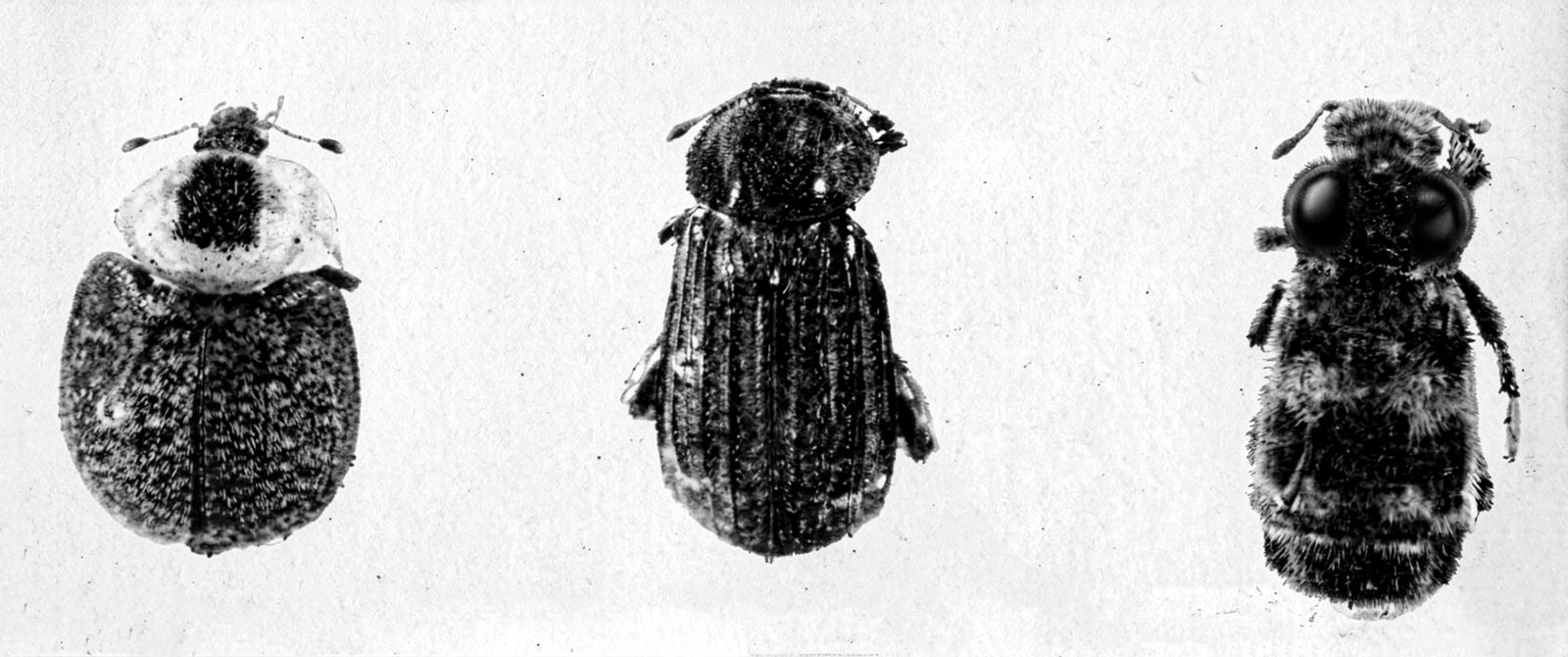
Of great interest to many insect collectors, alongside caterpillars, aphids, weevils, the longhorn beetle, the click beetle, fireflies, lady beetles or ladybugs, the leaf beetle of the family Chrysomelidae such as Leptinotarsa decemlineata, the tortoise beetle, the dung beetle, the soldier beetle, the blister beetle, the stag beetle, and even the occasional parasitic wasp, are members of the Coleoptera family Silphidae. This family of beetles, numbering over 500 species and distinct from the Carabidae or ground beetles, Staphylinidae or rove beetles, and the much smaller carpet beetles, are often large (½ to 1½ inches) and black, developing from subterranean grubs during the larval stage before entering the stage of a pupa, often with bright yellow and/or red ornamentation on the pronotum and elytra. The two most commonly found silphids are Necrophorus (Gr. “dead body + bearing”), the sexton or burying beetle, and Silpha (Gr. “a beetle”), the roving carrion beetle (Fig. 1). These beetles are insect collector favorites despite their putrescent habits.
In nature, examples of these two genera can be found under dead and decaying carcasses. Most silphids are flesh-feeding (although some members are phytophagous) and can be found feeding on the putrescent substrate or on maggots associated with the rotting carcass. Usually one mating pair occupies a carcass, and if interrupted by newcomers to the carcass, the presence of the intruders produces a fighting response. Once established, the mating pair actively buries the carcass in the soft topsoil. Though common in nature, silphids can be very difficult to collect in large numbers in their natural habitat.
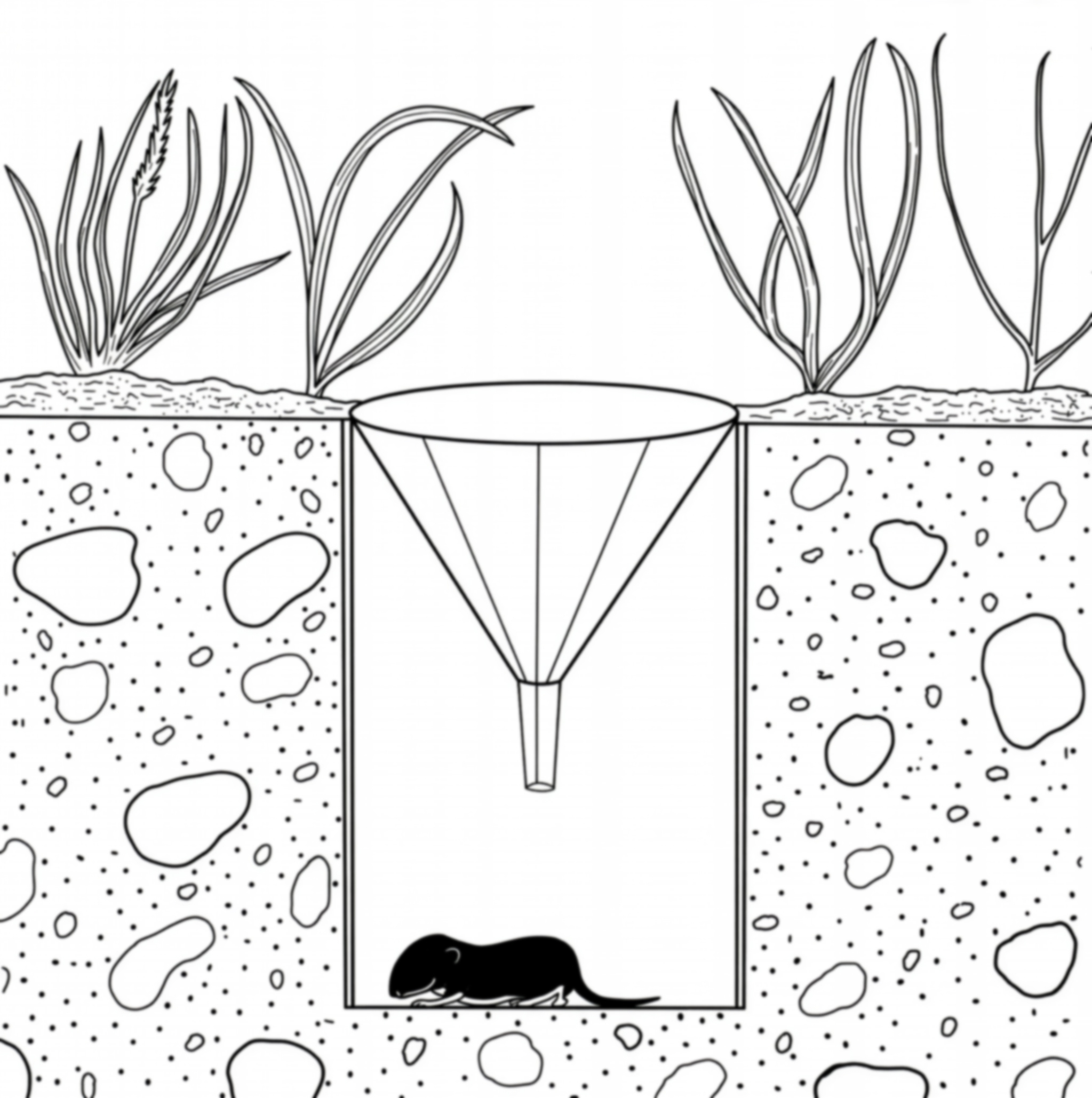
A collection of beetles can be a fascinating addition to a classroom, and they are easy to catch. Using a trap (Figs. 2, 3) can greatly increase the number of beetles collected per day. The trapping procedure is simple and only requires a 6-inch plastic funnel, a round one-gallon can, and a 1000-mL Erlenmeyer flask. Both Necrophorus and Silpha can be collected when temperatures rise above 60° F from late spring to early fall. When choosing a trapping location, a variety of habitats ensures a more representative beetle population. Once the specific site for the trap has been determined, dig a cylindrical hole so that the top of the can is within one inch of ground level. Activate the trap by placing a decaying carcass of a small animal (e.g., field mouse, bird, or fish) along the inner circumference at the bottom of the can. Then place the funnel over the can, making sure that the stem doesn’t touch the carcass (Fig. 2). Pull excess soil around the can and funnel and pack it down (Fig. 3). Be careful not to let loose soil fall into the can.
Silphids will be attracted to the decomposing carcass by smell. In nature, these beetles are generally found above ground during the day, their burying activities being nocturnal. We’ve found that the number of beetles collected between early afternoon and sunset ranged from 35 to 85 per day per trap, depending on the temperature. Once the beetles are trapped, remove the funnel and place it on the 1000-mL Erlenmeyer flask and invert the collecting can on the funnel. With a little shaking, the beetles may be easily channeled into the flask. Stopper the holding flask with a holed cork and store in a cool container until delivered to the laboratory.
Once in the laboratory, clean the putrescent fluids off the beetles. Place the beetles in a clean 1000-mL Erlenmeyer flask containing six loosely folded 18.5 cm sheets of filter paper. Repeat this process every 30 minutes until the specimens are clean and dry. Transfer the beetles to a flask containing wet paper towels (about 20 beetles per flask) and place them in a refrigerator at a temperature no lower than 15° C (18° C is recommended). This temperature immobilizes the beetles, letting them be kept for up to 2 weeks without feeding. Keeping the beetles unfed overnight in the laboratory at room temperature will cause them to act cannibalistic.
Silphid beetles can be reared in the laboratory with little difficulty and with minimum equipment. Lady beetles at many developmental stages and their diet can be purchased if the school environment doesn’t support trapping them. To trap beetles, fill a large earthen crock four inches below the top with damp sand and add the carcass of a fish, bird, or small mammal (latter preferred). Place one male and three female beetles in the crock and cover with a fine wire gauze, keeping the soil moist with occasional watering.
If you watch the beetles carefully, you can note several interesting habits. The male initially inspects the carcass and tests it with his palpi and antennae. He then makes a size determination by attempting to push the carcass. If the carcass is too large, the beetles will abandon it. If the beetles accept the carcass, the burying phase begins. They plow the soil, making sure it’s soft enough for burial. Beetles bury the carcass by using their heads as bulldozers and the tips of their claws as shovels. They use their powerful backs to move the carcass into position. The burying phase takes 5 to 8 hours, and the carcass is lowered 5 to 12 inches below the surface.
While burying the carcass, male and female beetles mate. Female beetles oviposit on, within, or near the decaying carcass. For the first few hours after hatching, larvae feed on regurgitated digestive products of the parent beetles, but after about 6 hours, larval beetles actively feed on the carrion. This process is repeated after each of the three larval instars until the adult stage is reached.
One type of commensalism associated with the carrion beetles is the phoretic mites they carry. If you examine the trapping can, holding flask, or earthen crock, many mites may be seen on the sides of the container and climbing on and off the living beetles. These mites don’t seem to hinder the beetles’ survival.
Overall, beetles offer science teachers a rich topic that combines anatomy, biodiversity, and life cycles in a highly visual way. By studying the head, thorax, abdomen, elytra, wings, and legs of different beetles, students can build a solid understanding of insect structure. By comparing species such as lady beetles, ground beetles, scarabs, weevils, fireflies, and darkling beetles, they can see how diversity grows from a shared body plan. Most importantly, by following the four stages of complete metamorphosis, students can better understand how organisms change across the life cycle. Beetles also play an amazing role in forensic science to help scientists solve crimes! Beetles turn everyday observations into meaningful science lessons that highlight the importance of our natural resources.
This article was originally published in Carolina Tips®, Vol. 36, No. 9 (July 1973); it was revised May 2026.
Comparative Metamorphosis MS (Grades 5-8) Student Activity
Lady Beetle Larvae Living Organism Care Guide
Acknowledgements
The authors are indebted to Dr. Martin J. Ulmer and Dr. Jean L. Laffoon for aid in preparation of
this paper.
Arthur L. Buikema, Jr., Ph.D. and Sara R. Sherberger
Biology Department
Virginia Polytechnic Institute and State University, Blacksburg, Virginia 24061
Get the latest news, free activities, teacher tips, product info, and more delivered to your inbox.