


9-12 High School
In this scientific inquiry activity, students investigate phenotypes using Wisconsin Fast Plants® seeds. After the seeds germinate, students identify the phenotypes and the possible associated genotype. Students can investigate possible Mendelian crosses by completing Punnett squares using the phenotypes they identified. If time permits, students can perform plant crosses of different phenotypes and determine if the predicted phenotypes from the Punnett squares appear in the F1 generations.
What are the typical variations in traits, or phenotypes, found in Wisconsin Fast Plants®?
Developing and Using Models
LS3: Heredity: Inheritance and Variation of Traits
Patterns
Ensure that students understand and adhere to safe laboratory practices when performing any activity in the classroom or lab. Use personal protective equipment such as safety glasses or goggles, gloves, and aprons when appropriate. Require students to adhere to all laboratory safety rules.
Dry plants out completely, place them in a resealable bag, and dispose of them in the trash. Plants may be allowed to continue to grow for additional investigations.
| Seed Stock (Item Number) | Genotype | Phenotype | Notes |
|---|---|---|---|
| Purple Stem, Hair (158810) | ANL/ANL (dominant) YGR/YGR ROS/ROS EIN/EIN DWF1/DWF1 | purple stem, sometimes extending to midribs of leaves; color varies from purple to dark pink | hair trait is quantitative and therefore best ignored in introductory activities |
| Non-Purple Stem, Hairless (158818) | anl/anl (recessive) | green stem | cross with 158810 for a monohybrid F1 |
| Yellow-Green Leaf (158843) | ygr/ygr (recessive) | yellow-green leaves, purple stems | cross with 158810 for a monohybrid F1, or with 158812 for a dihybrid F1 |
| Non-Purple Stem, Yellow-Green Leaf (158843) | anl/anl, ygr/ygr (double recessive) | yellow-green leaves, green stems | cross with 158810 for a dihybrid F1 |
| Rosette-Dwarf (158815) | ros/ros (recessive) | very short plant | internodes do not elongate |
| Tall Plant (158825) | ein/ein (recessive) | tall, spindly plant | abnormally tall due to elongation of internodes |
| Petite (158833) | dwf1/dwf1 (recessive) | reduced height | mature at 5-15 cm; normal is 17-20+ |
| Variegated (158820) | Var (non-Mendelian) | irregular leaf areas are devoid of chlorophyll | trait is part of the chloroplast genome, which is transmitted through the cytoplasm of the ovule; trait is not transmitted by pollen |
Record the number of seeds germinated each day for 4 or 5 days, or as your teacher instructs. Identify the color of the stem and the color of the leaves for each seed germinated.
| DAY | NUMBER OF SEEDS GERMINATED | PURPLE STEMS | GREEN STEMS | GREEN LEAVES | YELLOW-GREEN LEAVES |
|---|---|---|---|---|---|
| 1 | |||||
| 2 | |||||
| 3 | |||||
| 4 | |||||
| 5 | |||||
| Total |
Data will vary by group depending on the mixture of seeds they selected.
What are the 2 possible stem phenotypes?
Purple, hairy Non-purple, hairless
What are the 2 possible leaf phenotypes?
Yellow-green leaves and green leaves
Given your data, which phenotype appears to be dominant? Why?
Answers may vary depending on data, but purple, hairy is the dominant stem color and green leaf is the dominant leaf color.
How could you determine if a phenotype is inherited?
Cross a green stem plant with another green stem plant. Harvest and plant the seeds. If the plants that grow from the seeds have green stems, the phenotype is inherited. If some plants have purple stems, the green stem phenotype may not be inherited, and more study is needed.
Using the genotypes provided by your teacher, perform a dihybrid homozygous cross for purple stem color and green leaves with green stem color and yellow-green leaves. What are the phenotypes of the F1 generation?
F1 are all purple stem and green leaf, heterozygous.
ANL-YGR/ANL-YGR × anl-ygr/anl-ygr
| ANL-YGR | ANL-YGR | |
|---|---|---|
| anl-ygr | ANL/anl-YGR/ygr | ANL/anl-YGR/ygr |
| anl-ygr | ANL/anl-YGR/ygr | ANL/anl-YGR/ygr |
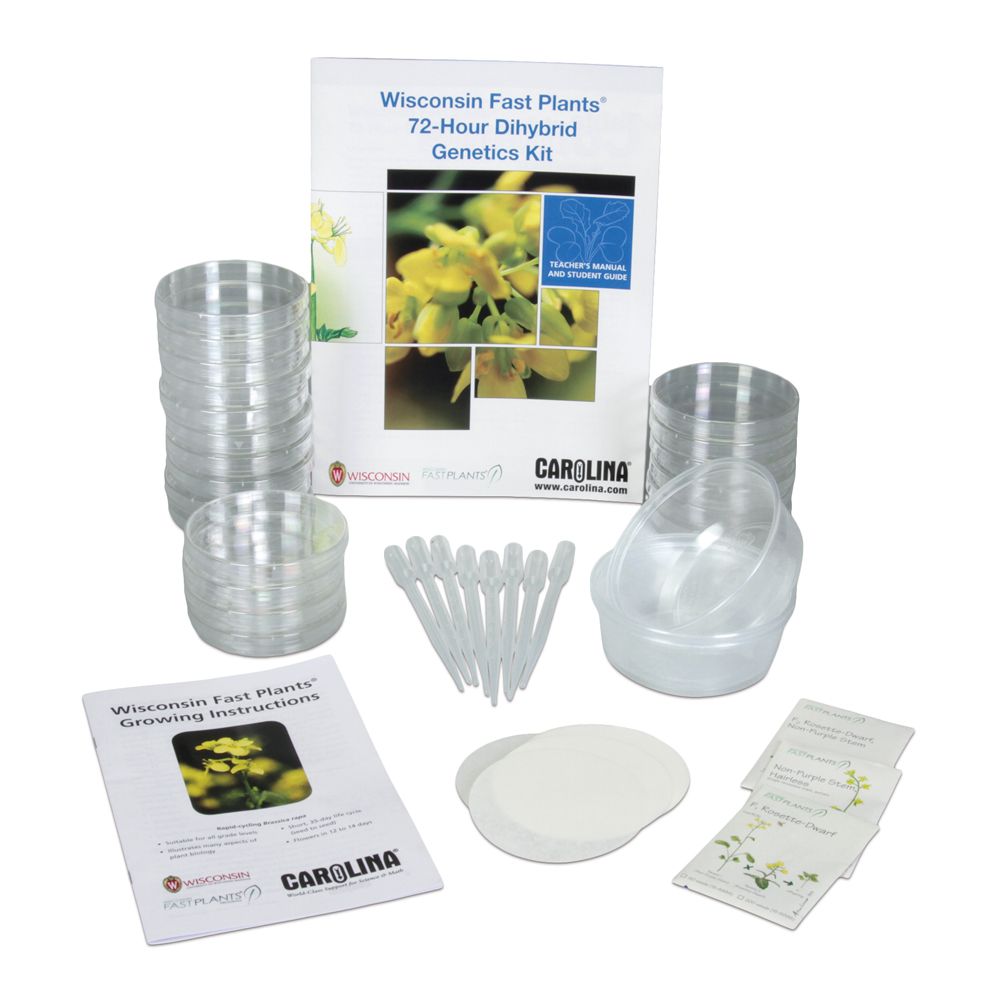
Students can nurture Wisconsin Fast Plants® through an entire life cycle in only 40 days.
*Next Generation Science Standards® is a registered trademark of Achieve. Neither Achieve nor the lead states and partners that developed the Next Generation Science Standards were involved in the production of this product, and do not endorse it.
Get the latest news, free activities, teacher tips, product info, and more delivered to your inbox.