



8-12 Middle/High School
Understanding vision requires a knowledge of physics, anatomy, and physiology. This activity emphasizes the physics of vision. By performing 2 simple activities that can be completed in less than 30 minutes, students investigate parallax and depth perception. Simple ray diagrams illustrate the interaction of light rays (physics) with the anatomy of the eye.
How can physics be used to explain vision?
PE HS-LS1-1. Construct an explanation based on evidence for how the structure of DNA determines the structure of proteins which carry out the essential functions of life through systems of specialized cells.
Developing and Using Models
LS1.A: Structure and Function
Structure and Function
Safety goggles required. Use unsharpened pencils only. If using glass test tubes, make sure there are no chips or cracks on the rim of the tubes. Collect pencils and test tubes from students.
Print, draw, or cut out bars about 1 inch high by 3 inches wide for 2 to 3 groups to share. Hang them on different walls, at student eye level. Students should stand 2 to 3 feet from the image.
Students should report that the bar appears to move. When the right eye is closed first, the bar appears to move to the right. When the left eye is closed first, the bar appears to move to the left.
It will take multiple attempts for students to get the pencil in the test tube. Depth perception has been altered.
1. Explain how Activity 1 illustrates the concept of parallax.
Parallax is defined as the apparent change in the position of a distant object due to the change in position of the observer. When a subject has one eye closed, the position at which light enters the open eye and is perceived by the brain is different than the position of the closed eye once it is reopened.
2. Explain why it was difficult to place the pencil in the test tube.
Each eye perceives a different image, but there is a large area where the field of view of each eye overlaps and the visual cortex processes this as a single image. This process also allows the brain to estimate distance, which is known as depth perception. Although the brain uses other clues to perceive depth, when one eye is lost or simply closed, depth perception can be affected.
3. Complete a ray diagram or sketch for both activities.
Parallax

An illustration of parallax of an object against background due to a perspective shift. When viewed from Viewpoint A, the object appears to be in front of the blue square.
When the viewpoint is changed to Viewpoint B, the object appears to have moved in front of the red square.
Depth Perception

4. Humans and other predators have binocular stereoscopic vision because their eyes are on the fronts of their heads. Rabbits and many other prey animals have panoramic fields of view because their eyes are on the sides of their heads. What advantages does each type of vision provide?
Predators must judge distance and speed to catch a prey so binocular stereoscopic vision is beneficial. Prey need a wider angle of vision to detect predators.
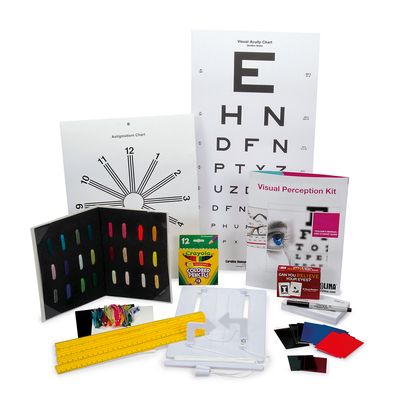
This comprehensive kit enables students to investigate many of the physiological processes involved in human vision.
We are committed to providing the lab kits, instructional materials, and often free activities and supporting digital resources that do as much heavy lifting for you as we can.



*Next Generation Science Standards® is a registered trademark of Achieve. Neither Achieve nor the lead states and partners that developed the Next Generation Science Standards were involved in the production of this product, and do not endorse it.
Get the latest news, free activities, teacher tips, product info, and more delivered to your inbox.