



9-12 High School
This quantitative investigation provides students with an introductory sensation and perception activity. The activity can be used as a unit introduction for human senses or as a stand-alone olfactory sensation activity. Students use fragrant oils to determine the time of olfactory fatigue for both of their nostrils and then examine the link between smell and memories. If time permits, class olfactory fatigue data may be analyzed to examine class averages or look for the possibility differences based on genetics, medical conditions, or life style.
How do structures in the body enable human beings to sense their environment?
Practice: Developing and Using Models
DCI: LS1.A: Structure and Function
Concept: Systems and System Models
Students should wash their hands after entering and before exiting the lab. Students should be in safety glasses to conduct the investigation. Supervise students conducting the tasting activity. Safety goggles required.
Place all cotton swabs in a re-sealable bag and dispose of them in accordance with your school chemical hygiene plan.
Times will vary based on room conditions.

1. Was the peppermint oil smelled immediately after the diminished odor of the clove oil? What is the explanation for the nose’s ability to detect new or different odors?
Yes. The nose remains immediately sensitive to any new or different odor.
2. How do the fatigue times of the clove oil and peppermint oil compare when sniffed in succession with the right nostril?
The times are approximately the same.
3. Is the fatigue time for the left nostril significantly different than the right nostril?
The fatigue times should be similar.
4. When you smelled the cloves and the peppermint, did you recall any memories associated with those odors? If so, briefly describe them.
Student answers will vary.
5. Diagram the process of smelling the peppermint oil.
In the human body, specialized nerve cells respond to conditions in the environment and send a signal through other nerve cells to the brain. These specialized nerve cells have structures called sensory receptors, structures that will only respond to a specific kind of stimulus. For each type of receptor, nerve cells provide information in the same “all or nothing” manner. A stimulus is either sufficient to cause a cell to fire, transmitting a nerve impulse to the brain or spinal cord, or it is not. For instance, a light receptor cell in the eye may respond only to red light. If a light receptor for red light “sees” red, it discharges. Although air is always around you, you do not feel the air unless it is moving over your skin in the form of a current or as wind.
Nerve impulses travel through nerve fibers to the brain, where the impulses are processed. By analyzing all the inputs from the sense organs, the brain interprets the appropriate responses, which we perceive as seeing, feeling, hearing, smelling, and tasting. If an injury causes the nerves in a sense organ to be damaged or severed, the brain can no longer obtain accurate information from that nerve, even if the sense organ is healthy and might be receiving impulses from stimuli.
Step 1: Source releases aromatic compounds
Step 2: Aromatic compounds are trapped by the mucus lining in the nose.
Step 3: The sensory receptors in the nose are triggered.
Step 4: Nerve impulse is sent to the brain.
Step 5: Nerve impulse is interpreted.

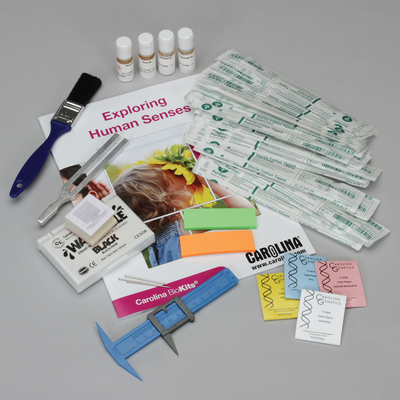
Provide students with materials and procedures to explore the human senses of sight, hearing, touch, taste, and smell.
We are committed to providing the lab kits, instructional materials, and often free activities and supporting digital resources that do as much heavy lifting for you as we can.



*Next Generation Science Standards® is a registered trademark of Achieve. Neither Achieve nor the lead states and partners that developed the Next Generation Science Standards were involved in the production of this product, and do not endorse it.
Get the latest news, free activities, teacher tips, product info, and more delivered to your inbox.