Introduction
Activity Details
- Prep Time: 15 minutes
- Class Time: 45-60 minutes
Materials
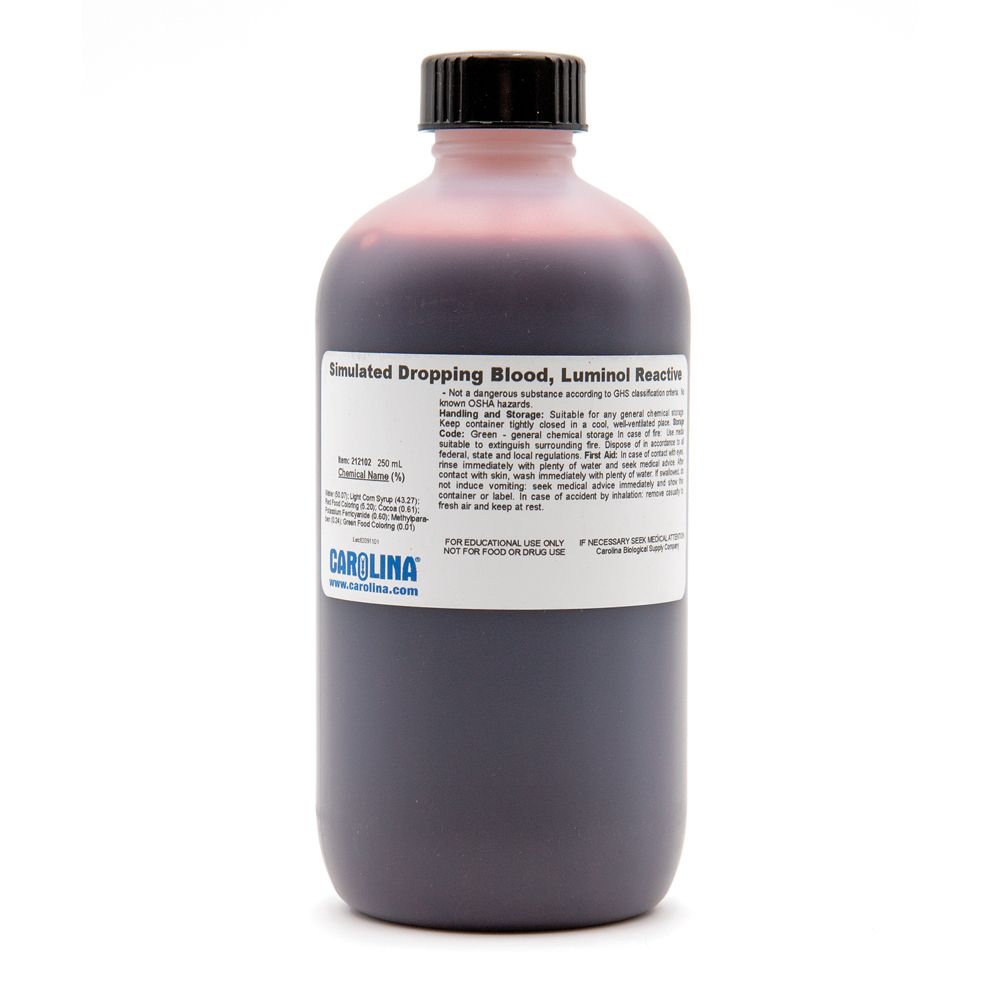
- Carolina® Luminol Reactive Forensic Blood, 250 mL
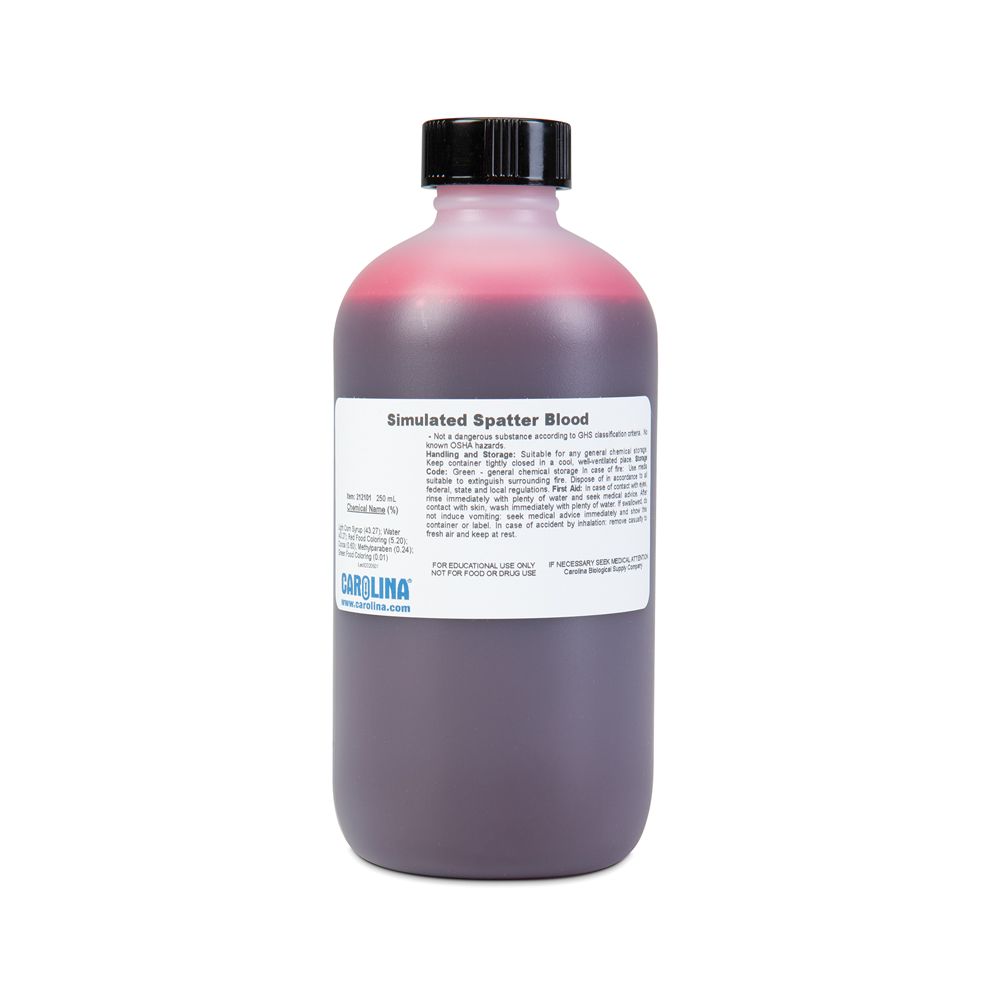
- Multiple Blood-like Substances (simulated blood, ketchup, hot sauce, etc.)
- Luminol, 0.18 g
- Luminol Blood Detection Student Investigation Sheet (one per student)
- Surface for Blood Stains (fabric or wood preferred)
- Clorox 2 Powder, 10 g
- Water, 60 mL
- Small Spray Bottle (preferred) or Drop Bottle
Investigation question
Investigation objective
Safety

Standards
This activity addresses the following AP® Biology concepts:
SYI-1
Living systems are organized in a hierarchy of structural levels that interact.
SYI-1.A
Explain how the properties of water that result from its polarity and hydrogen bonding affect its biological function.
SYI-1.A.3
The hydrogen bonds between water molecules result in cohesion, adhesion, and surface tension.
Activity
Teacher Preparation
-
Prepare the luminol solution the morning of the investigation.
a. Combine 0.18 g of luminol, 10 g of Clorox 2 powder, and 60 mL of water in a 100-mL beaker. Stir the mixture with a glass stirring rod.
b. Allow the mixture in the beaker to sit for 10 minutes.
c. After at least 10 minutes have elapsed, decant the luminol/Clorox 2/water
mixture into the labeled spray bottle or dropper bottles.
d. Repeat steps a–c for as many luminol spray solutions as you have student groups.
-
Create a mock crime scene by applying a drop of luminol reactive blood and non-reactive blood substances on a piece of fabric or on a wood table. Create as many mock crime scenes as you have student groups.
Procedure
- Observe the crime scene and record your observations for each stain.
- Make a prediction on which stains are blood and which are not based on your observations.
- Obtain luminol solution from your teacher.
- Turn off the classroom lights and spray each stain with the luminol solution. When luminol reacts with blood, it produces blue light without heat (a reaction called a chemiluminescent reaction). Luminol does not produce blue light when reacting with other substances. Record your results for each stain in the luminol column.
- Based on your visual observations and luminol tests, write a conclusion on which bloodstains are and are not blood. Explain your reasoning.
- Clean and dispose of lab supplies as directed by your teacher.
Analysis
- Did your predictions match your conclusion? Explain why you think they did or did not.
- Describe what can and cannot be learned from a visual observation of stains that appear to be blood.
- What type of a reaction is the luminol reaction?
- Explain why it is valuable for forensic investigators to perform chemical blood tests, such as the luminol test you performed, when analyzing suspected blood stains.
- Research questions:
a. What causes luminol to glow during a reaction?
b. What chemically causes luminol to react with human blood and not with other substances?
c. Can investigators be confident in the results of luminol tests or are there additional factors to consider that may cause a false positive or negative result?
Sample Answers
| Sample | Bloodstain A | Bloodstain B | Bloodstain C | Bloodstain D |
|---|---|---|---|---|
| Observations: (color texture, stain shape) | Bright red, thick, and tear drop shaped | Dark red, thin, tear drop shaped | Dark purple, thick, streaked line | Pale red, light and thin, smeared |
| Prediction: | Blood | Not Blood | Not Blood | Blood |
| Reaction with Luminol: | No | Yes | No | No |
| Conclusion: | Bloodstain A visually appears like human blood, but luminol testing demonstrated that it is not blood | The test results for Bloodstain B are consistent with human blood in both appearance and reactivitiy with luminol. | Bloodstain C visually appears like human blood, but luminol testing demonstrated that it is not blood. | Bloodstain D visually appears like human blood, but luminol testing demonstrated that it is not blood. |
Activity Extension Ideas
- What effect does the surface a bloodstain is on have on the effectiveness of luminol blood tests?
- Does temperature influence the brightness of luminol reactions?
- Do wet samples react with luminol as well as dry samples?