Your students probably know oil and water don’t mix, but do they know why? Creating density columns by layering immiscible liquids of decreasing densities and different colors in this activity gives them an engaging hands-on opportunity to answer that question and many more. Ramp up your students’ interest even further with a challenge to create as many distinct layers as they can. There are also other advantages to conducting this activity. The necessary liquids are readily available, inexpensive household products. It is easy to simplify or expand the activity by limiting or increasing the number of liquids you make available. And the classroom time necessary for creating density columns is very flexible and can range from 10 minutes to an hour, depending on the number of liquids available and amount of instruction you provide.
*Graduated cylinders and test tubes work well but can be difficult to clean. You may prefer to use clear disposable cups or jars.
NGSS Standards
NGSS SEPs:
• Developing and Using Models
• Planning and Carrying Out Investigations
• Analyzing and Interpreting Data
NGSS DCIs:
• PS1.A: Structure and Properties of Matter
• PS2.B: Types of Interactions
• PS2.C: Stability and Instability in Physical Systems
Activity
Preparation (teacher)
Determine the amount that you need of each liquid. Consider factors such as class size, students’ abilities, and container size.
Gather the materials. You might try to find parent volunteers to supply the various liquids.
Add a drop or 2 of food coloring to each clear liquid to make subsequent layers more visible. (You may prefer that students perform this step.) Be aware that the food coloring will not color the oils.
Procedure (student)
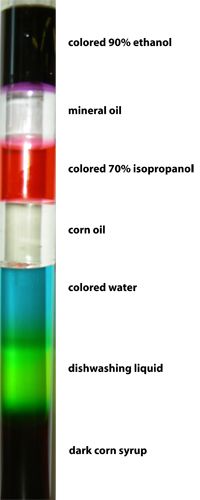
Create a column with as many layers as possible. See Fig. 1.
Make layers of liquids at least ½” thick so they will be easy to distinguish.
Pour liquids gently to avoid disrupting existing layers. You many use disposable pipets for adding liquids.
Compare and discuss your columns. Integrate topics of density, miscibility, polar–nonpolar interactions, and surface tension.
Figure 1 A 7-layer column.
Extension
Challenge students to predict where small items such as beads, popcorn kernels, balls of clay, or pieces of paraffin wax will come to rest when dropped into the column. Also, have them determine if there is a difference in where the item stops when gently lowered to the top layer, as opposed to dropped to the top layer.
Have students investigate how temperature affects density. Heat water dyed with food coloring to almost boiling. Then, add a few drops of a different food coloring to almost freezing water. Layer the hot water over the ice water. Have students hypothesize where an ice cube added to this water column will come to rest. Test the hypothesis. Link this activity to a discussion of thermoclines, thermal inversion, and “turnover” in bodies of water.
Ask students to answer the question, “How does salt concentration affect density?” Create a concentrated salt solution and add food coloring. Add a different color to a quantity of plain water. Layer the plain water over the saltwater. Then ask students to answer the question, “How does this model relate to bays and estuaries where rivers empty into the ocean?”
Safety
Note:Wear chemical splash goggles when conducting this investigation. After completing this activity, place the used liquids in a sealed container and dispose of according to your school system’s guidelines. Never pour any oils down a drain.
Carolina is teamed with teachers and continually provides valuable resources–articles, activities, and how-to videos–to help teachers in their classroom.